Wednesday, May 11, 2016

Pope Francis invokes St. John Paul II ahead of Fatima feast


Pope Francis invokes Our Lady of Fatima during last year's general audience, held on 13 May 2015. - AFP

Pope Francis invokes Our Lady of Fatima during last year's general audience, held on 13 May 2015. - AFP


11/05/2016 11:46
(Vatican Radio) Pope Francis on Wednesday said Our Lady of Fatima “invites us once again to turn to prayer, penance, and conversion.”


The Holy Father noted the Feast of Our Lady of Fatima is commemorated this year on this Friday (13 May) during his remarks to Polish-speaking pilgrims at his General Audience.


“She asks us to never offend God again. She forewarns all humanity about the necessity of abandoning oneself to God, the source of love and mercy,” Pope Francis said.
“Following the example of St. John Paul II, a great devotee of Our Lady of Fatima, let us listen attentively to the Mother of God and ask for peace for the world,” – he continued – “Praised be Jesus Christ!”


Thirty-five years ago, Pope St. John Paul II was shot by Mehmet Ali Ağca during the General Audience, which took place on the Feast of Our Lady of Fatima in 1981.
The saint attributed his survival to Our Lady, and gave one of the bullets used in the attack to the Shrine of Our Lady of Fatima in Portugal. The bullet was placed in the crown of the statue of the Virgin Mary which is housed at the shrine.


....


Taken from: http://en.radiovaticana.va/news/2016/05/11/pope_francis_invokes_st_john_paul_ii_ahead_of_fatima_feast/1228967

Sunday, May 1, 2016

Pope Francis and the Satanist


by Deacon Nick Donnelly  •  ChurchMilitant.com  •  May 1, 2016
                                           
Pope Francis, like a number of other modern popes, has a devotion to Bd. Bartolo Longo. Pope St. John Paul II beatified Bartolo Longo in 1980 and presented him as an exemplar of a life made holy by praying the Most Holy Rosary:
As a true apostle of the Rosary, Blessed Bartolo Longo had a special charism. His path to holiness rested on an inspiration heard in the depths of his heart: "Whoever spreads the Rosary is saved!" As a result, he felt called to build a Church dedicated to Our Lady of the Holy Rosary in Pompeii, against the background of the ruins of the ancient city, which scarcely heard the proclamation of Christ before being buried in 79 A.D. during an eruption of Mount Vesuvius, only to emerge centuries later from its ashes as a witness to the lights and shadows of classical civilization. By his whole life's work and especially by the practice of the "Fifteen Saturdays," Bartolo Longo promoted the Christocentric and contemplative heart of the Rosary, and received great encouragement and support from Leo XIII, the "Pope of the Rosary."  (Apostolic Letter on the Rosary, "Rosarium Virginis Mariae").
However, if you type "Bartolo Longo" into a search engine you'll get some shocking headlines: "The Satanist on the Path to Sainthood"; "Pompeii and a Satanist Turned Saint"; "Satanism, Pompeii and the Rosary — a Bizarre Tale Surrounds Francis' Next Trip."
In 2014 Pope Francis flew by helicopter from the Vatican to Pompeii to visit the only Church dedicated to Our Lady of the Holy Rosary built by a former satanist. The Church has been raised to the status of a pontifical basilica and is home to a miraculous image of Our Lady of the Rosary.
Pope Francis composed a special prayer dedicated to Our Lady of the Rosary, which he prayed before the sacred painting. His words refer to the deep wounds of sin that plague us and our society:
We entrust our miseries, the many streets of hate and blood, the thousands of ancient and new poverties and above all, our sins. To you we entrust ourselves, Mother of Mercy: grant us the forgiveness of God, help us to build a world according to your heart. O Blessed Rosary of Mary, sweet chain that ties us to God, chain of love that makes us brothers, we will not leave you again. You will be in our hands a weapon of peace and forgiveness, star that guides our path.
Bartolo Longo's life is testimony to the power of the Most Holy Rosary to heal very serious, very deep wounds inflicted by the devil and sin. Bartolo was born on February 10, 1841, the son of devout Catholic parents who daily prayed the Rosary as a family.
Bartolo's father died when he was only 10 years old, his mother remarried and he began to drift away from the Faith. During his studies at Naples University Bartolo became involved with the occult, taking part in séances, fortune-telling and sexual promiscuity. He was drawn deeper into occult practices, becoming a member of a satanic cult and eventually being initiated into the satanic priesthood.
Like many involved in the occult and satanism, he was afflicted with demonic oppression, which was ruining his life. People suffering from demonic oppression experience self-destructive thoughts, self-harming, the urge to actions that are damaging to themselves and others. Bartolo has been described as suffering "despair, fear, hate, anger, an inability to forgive, resentment, and thoughts of suicide."
Sinking deeper into self-destructive darkness, one day Bartolo heard the voice of his dead father beseech him, "Return to God! Return to God!" A friend of Bartolo put him in touch with a Dominican priest, Friar Alberto Radente, who taught him about the healing power of the Most Holy Rosary. At the age of 30 on October 7, 1871, the feast of Our Lady of the Rosary, Bartolo became a Dominican tertiary and took the name "Rosario."
Following his conversion Bartolo returned one last time to a séance at which he held up a Rosary and declared, "I renounce spiritualism because it is nothing but a maze of error and falsehood." But Bartolo's struggles against occultism didn't stop with that séance. In the town of Pompeii, Bartolo found Catholics trapped by the same superstition and dark practices. He longed to bring them the healing he had found through the Rosary. To this end Bartolo promoted devotion to the Rosary by forming a Confraternity of the Rosary, by restoring a dilapidated church dedicated to Our Lady of the Rosary and by personally sponsoring an annual festival in honor of Our Lady of the Rosary. Bartolo also established the Marian devotion the Supplication to the Queen of Victories, first prayed in Pompeii on October 1883, and which is now recited all over the world on May 8, and on the first Sunday in October.
As well as these Spiritual Works of Mercy, Bartolo Longo was inspired by his deep love for Our Lady and the Church to radical Corporal Works of Mercy, in the words of Pope St. John Paul II, transforming "Pompeii into a living citadel of human and Christian goodness." He established orphanages, Sons of Prisoners, Daughters of Prisoners, Daughters of the Holy Rosary of Pompeii and Dominican Tertiaries.

The Miraculous Painting

Miraculous painting of Our Lady


20150315_121438


In 1875 Bartolo received a special grace, though he didn't know it at the time. Father Radente gave him a painting of Our Lady of the Rosary. In bad condition, the painting was also of poor artistic quality. If that wasn't enough to put Bartolo off the painting, it had been brought to him in the back of a cart used to transport manure around the farms. However, seeing that it came as a gift from the priest who had helped him in his darkest hour, Bartolo accepted it, paid for it to be restored and placed it in the church he had renovated. The painting portrays Mary seated on a throne holding the child Jesus and handing a Rosary to St. Dominic and St. Catherine of Siena, who are standing at her feet. The moment Bartolo hung the painting in the church, miracles began to happen. On the very first day, 12-year-old Clorinda Lucarelli was completely healed of epileptic seizures diagnosed as incurable.
A year after the first miracle, Bartolo began the construction of a larger church that was completed in 1891, becoming the Pontifical Basilica of Our Lady of the Most Holy Rosary of Pompeii. Bartolo "Rosario" Longo died in 1926 at the age of 85. His final words were "My only desire is to see Mary who saved me and who will save me from the clutches of Satan."
Blessed Paul VI had a deep devotion to this miraculous painting of Our Lady of the Rosary, and following more restoration work, had it temporarily displayed in St. Peter's Basilica, before its return to Pompeii. During his veneration of the sacred image Pope Paul VI said, "[J]ust as the image of the Virgin has been repaired and decorated ... so may the image of Mary that all Christians must have within themselves be restored, renovated and enriched."
In our own time, with the growing acceptance of depraved evil, satanists are becoming more brazen, raising up statues to Satan and other demons in Detroit and London. In His providence, God has given us Bd. Bartolo Longo, and the personal devotion of so many modern popes, to assist us in battling and defeating Satan through the power of the Most Holy Rosary.
Blessed Bartolo "Rosario" Longo, pray for us.

Deacon Nick Donnelly is an author based in the diocese of Lancaster, England. You can follow him at @protectthepope.

....

Taken from: http://www.churchmilitant.com/news/article/pope-francis-and-the-satanist

Sunday, April 3, 2016

Pope Francis Makes Surprise Announcement at Divine Mercy Prayer Vigil


VATICAN CITY — Pope Francis has made a surprise announcement to dioceses around the world, on the eve of Divine Mercy Sunday.
Addressing faithful in St. Peter’s Square at a Saturday evening prayer vigil for the Jubilee of Divine Mercy — 11 years to the day after the death of St. John Paul II — the pope announced his wish that, in every diocese, “a hospital, a home for the elderly, for abandoned children, a school where none exists, a home for the recovery of addicts,” or some similar structure be established as “a living memory” of the Year of Mercy.


The Pope said the idea came to him recently during a meeting with directors of a charitable agency. But he thought to himself: “I will share it in the square on Saturday.”
“There are so many things that could be done,” he said. “It would be very good for each diocese to consider: what can we leave as a living memory, as a work of living mercy, as a wound of the living Jesus for this Year of Mercy? Let us reflect on this and speak to the bishops about it.”
The surprise announcement came after Pope Francis told pilgrims at the prayer vigil that “a faith that cannot be merciful, as the Lord’s wounds were a sign of mercy, is not faith: it is an idea, an ideology.”
In Jesus, he said, “we are able not only to touch the mercy of God with our hands, but we are inspired to become instruments of his mercy.”
“A faith that is not able to touch the Lord’s wounds, is not faith!” he continued in impassioned and unscripted remarks. “Our faith is incarnated in a God who was made man, who became sin (cf. 2 Cor. 5:21), who was wounded for us. But if we really want to believe and have faith, we must draw near and touch those wounds, caress those wounds and even lower our head and allow others to sooth our wounds.”
The Divine Mercy prayer vigil also featured readings from Scripture, sacred music, and the Chaplet of Divine Mercy.


Here below we publish the official English text of Pope Francis’ address.

Dear brothers and sisters,


Good evening! With joy and thanksgiving we come together to share this time of prayer that begins Mercy Sunday. It is a liturgical feast which Saint John Paul II ardently desired, and a response to the request of Sister Faustina. The testimonies offered – for which we are grateful – and the readings we have just heard provide us the light and hope needed to enter the great ocean of God’s mercy. How many are the expressions of mercy with which God encounters us? They are numerous and it is impossible to describe them all, for the mercy of God continually increases. God never tires of showing us mercy and we should never take for granted the opportunity to receive, seek and desire this mercy. It is something always new, which inspires awe and wonder as we see God’s immense creativity in the ways he comes to meet us.
God has revealed himself, on many occasions, through his name which is “mercy” (cf. Ex 34:6). How great and infinite is the nature of God, so great and infinite his mercy, to the point that it is greatly challenging to describe it in all its entirety. Through Sacred Scriptures, we find that mercy is above all the closeness of God to his people. It is a closeness expressed essentially through help and protection. It is the closeness of a father or mother reflected in the beautiful words of the prophet Isaiah: “I led them with cords of compassion, with the bands of love, and I became to them as one who eases the yoke on their jaws, and I bent down to them and fed them” (11:4). This image is extremely evocative: God picks each one of us up and holds us to his cheek. How much tenderness and love is expressed here! I had these words of the prophet in mind when I saw the image for the Jubilee. Jesus not only carries humanity on his shoulders, but his face is so closely joined to Adam’s face that it gives the impression they are one.
We do not have a God who is incapable of understanding and sharing our weaknesses (cf. Heb 4:15). Quite the contrary! Precisely because of his mercy God became one of us: “For by his incarnation the Son of God has united himself in some fashion with every man. He worked with human hands, he thought with a human mind, acted by human choice and loved with a human heart. Born of the Virgin Mary, he has truly been made one of us, like us in all things except sin” (Gaudium et Spes, 22). In Jesus, therefore, we are able not only to touch the mercy of God with our hands, but we are inspired to become instruments of his mercy. It is easy to speak of mercy, yet more difficult to become its witness. This is a path that is lifelong and which should not be interrupted. Jesus has said to us that we must be “merciful as the Father” (cf. Lk 6:36). It is a lifelong endeavour.
How many expressions there are, therefore, of God’s mercy! This mercy comes to us as closeness and tenderness, and because of this, comes also as compassion and solidarity, as consolation and forgiveness. The more we receive, the more we are called to share it with others; it cannot be kept hidden or kept only for ourselves. It is something which burns within our hearts, driving us to love, thus recognizing the face of Jesus Christ, above all in those who are most distant, weak, alone, confused and marginalized. Mercy seeks out the lost sheep, and when one is found, a contagious joy overflows. Mercy knows how to look into the eyes of every person; each one is precious, for each one is unique. How painful it is when we hear it said: “These people… these people, these poor people, let’s throw them out, let’s let them sleep on the street…” Is this of Jesus?


- See more at: http://aleteia.org/2016/04/02/pope-francis-makes-surprise-announcement-at-divine-mercy-prayer-vigil/#sthash.yDEuoRSq.dpuf

Saturday, March 12, 2016

Making the theme of mercy “a real central characteristic of Catholic life.”

mercy-year


UK Cardinal: The reason for Pope Francis' remarkable energy


2016-03-12 Vatican Radio
(Vatican Radio)  Three years ago this Sunday (March 13th) Pope Francis, the former Cardinal Jorge Bergoglio from Argentina, stepped out onto the balcony of the Vatican Basilica. His election stunned the world.
Not only was he the first Pope from Latin America, he was also the first Jesuit Pope and the first ever to take the name of Francis.
Cardinal Vincent Nichols, Archbishop of Westminster, is the head of the Catholic Church in England and Wales and Susy Hodges asked him to reflect on this papal anniversary and analyse the impact of Pope Francis’ papacy on the Church and review some of the highlights of these past three years.

Listen to the interview with Cardinal Vincent Nichols, Archbishop of Westminster:


Cardinal Nichols said that for him one surprising thing about Pope Francis is his “remarkable energy, his vibrant presentation of the gospel” and his “ability to maintain a very full, personal and heartfelt presence.” He said he believes the reason for this energy this can be found in the Pope’s deep relationship with the Lord.
“Nothing else could give a man of his age the kind of vitality and freshness that he’s sustained over these past three years.” 
Cardinal Nichols goes on to describe how the Pope Francis’ fidelity to the Lord and his message, together with his concern for people, “especially those on the margins of society,” is what “captures and enthralls the world.”
“Not a reformation of the papacy”
When asked about ways in which Pope Francis has changed the papacy, Cardinal Nichols cautions that “this is not a reformation of the papacy” as some would have us believe. He said there’s a “great continuity among the Popes, along with “a freshness” and “difference” with each new incumbent.
Turning to the question of what challenges face the Church, the English cardinal singled out the Pope’s desire to “galvanise” the Church around this Jubilee Year of Mercy, describing this as “an enduring challenge” to make the theme of mercy “a real central characteristic of Catholic life.”
“That’s the biggest challenge he sets us,” said Cardinal Nichols.

(from Vatican Radio)

....

Taken from: http://www.news.va/en/news/uk-cardinal-the-reason-for-pope-francis-remarkable 

Sunday, February 28, 2016

Pope Francis: It's never too late for conversion


By Ann Schneible


.- God's patience towards sinners is without limit, yet the time for conversion is now, Pope Francis said during his Sunday Angelus address at the Vatican.
“It is never too late to convert, but it is urgent, it is now! Let us begin today,” said the Pope Feb. 28 to the crowds in St. Peter's Square.
Delivering his remarks before leading those present in the Marian prayer, the Pope spoke on Jesus' “invincible patience,” explaining how God's “unyielding concern for sinners” should provoke impatience in ourselves.
“Have you thought of God's patience? Have you even thought of his unyielding concern for sinners, how this should provoke impatience against ourselves?”
“It is never to late to convert! Never! Up until the last moment: The patience of God who waits for us.”
Pope Francis recounted the story from St. Therese of Lisieux, who prayed for the conversion of a criminal who had been condemned to death, and had refused interventions from the priest. It was not until his final moment that he took the Crucifix held by the priest and kissed it.
“The patience of God! And he does the same with us, with all of us!” the Pope said. “And this is his mercy.”
Reflecting on the day's readings, Pope Francis remarked how everyday newspapers report on violence and catastrophes. He tied this to the Gospel reading which refers to two tragic events of the time: the Romans sacking the temple, and the collapse of the Siloam tower in Jerusalem which killed eighteen people.
The Pope says Jesus knows his listeners are “superstitious” in interpreting such events as punishment for sins.
“Jesus definitively refutes this point of view, because God does not permit tragedies to punish sins,” he said, but “asserts that those poor victims were no worse than others.”
Rather, Jesus uses these examples as warnings that sinners will perish as these victims did if they do not repent, the Pope added, citing the Gospel.
Even today, there is the temptation to blame disasters on the victims, “or even on God himself,” the pontiff said.
However, in order to take the path of the Gospel, Jesus “calls us to change our heart, to radically make an about turn in our life, abandoning our compromises with evil,” the Pope said, citing hypocrisy as an example. “I think we all have in us a little bit of hypocrisy,” he said in an off-the-cuff remark.
Stressing the need for conversion, the Pope warned against the temptation toward self-justification: “From what do we need to convert? Are we not all good people, believers, even sufficiently practicing?”
Despite being like the fig tree which fails to produce fruit, Jesus “with limitless patience” delays killing the tree for another year, Pope Francis observed.
He reflected on the Jubilee Year of Mercy as a year of grace, the period in the Church and our lives before Christ's “glorious return,” and which is “punctuated by a certain number of Lents which offer us opportunities for repentance and salvation.”
The Jubilee of Mercy is an Extraordinary Holy Year which officially commenced December 8 – the Solemnity of the Immaculate Conception – with the opening of the Holy Door in St. Peter's Basilica. It will close Nov. 20, 2016 with the Solemnity of Christ the King.
After the recitation of the Angelus, Pope Francis reflected on the ongoing crisis of refugees fleeing from “war and other inhumane situations.”
He especially acknowledged Greece and other countries “on the front line” for their work in offering “generous assistance” to those crossing their borders, and called on the international community for a “unanimous response” in helping distribute the weight of the crisis.
“For this reason, we need to firmly and unreservedly focus on negotiations,” he said.
The pontiff went on to welcome “with hope” the current ceasefire in Syria involving government and rebel forces, which has entered its second day.
“I invite all to pray so that this window of opportunity can give relief to the suffering people, encouraging the necessary humanitarian aid, and open the way to dialogue and much desired peace,” he said.
Pope Francis went on to extend his “closeness” to the  people of Fiji, where tropical cyclone Winston killed more than 40 people and left tens of thousands more homeless.

“I pray for the victims and for those engaged with the relief efforts.”


....


Taken from: http://www.catholicnewsagency.com/news/pope-francis-its-never-too-late-for-conversion-70124/

Sunday, February 14, 2016

Meeting of the Millennium: Pope Francis and Patriarch Kirill

pope francis, patriarch kirill, pope kirill meeting, catholic orthodox meeting, christianity, pope francis news, pope patriarch kirill meeting, pope kirill meeting, catholicism, orthodox christianity, pope in mexico, pope francis mexico

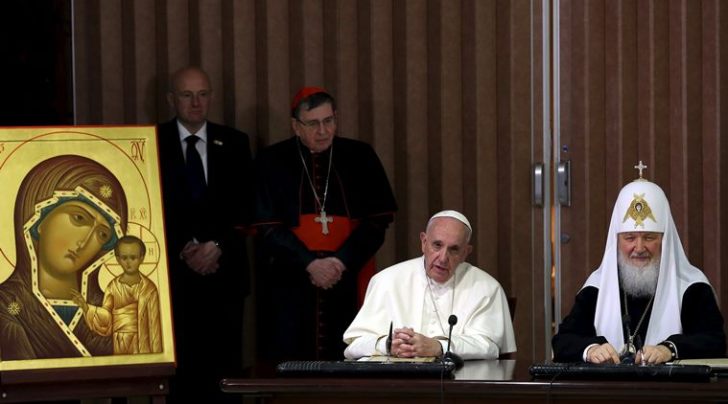
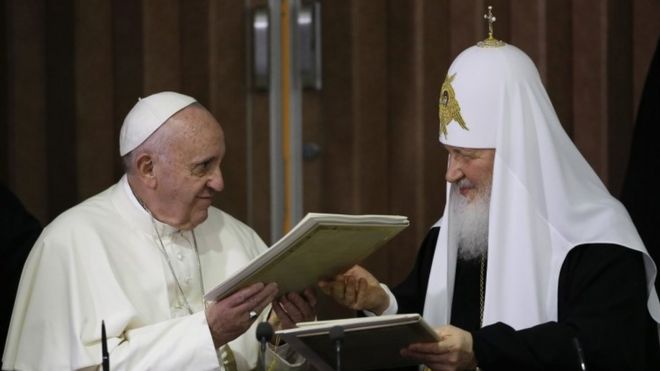
Pope Francis (L) addresses the audience after signing agreements with Russian Orthodox Patriarch Kirill in Havana, February 12, 2016. (REUTERS/Alejandro Ernesto/Pool)


Unity call as Pope Francis holds historic talks with Russian Orthodox Patriarch


Pope Francis (left) and Russian Orthodox Patriarch Kirill exchange a joint declaration on religious unity at the Jose Marti International airport in Havana, Cuba (12 February 2016)

Pope Francis and Russian Orthodox Patriarch Kirill have called for restored Christian unity between the two churches at historic talks in Cuba.
The meeting was the first between a Pope and a Russian Church head since the Western and Eastern branches of Christianity split in the 11th Century.
In a joint declaration, they also urged the world to protect Christians from persecution in the Middle East.
The Pope has now arrived in Mexico for a five-day visit.
A crowd of 300,000 braved the cold in Mexico City to welcome him to the country which has the world's second largest Catholic population.
The Pope was greeted at the airport by President Enrique Pena Nieto.

'Churches ravaged'

The two-hour talks on Friday between Pope Francis and Patriarch Kirill were held at Havana airport.
Patriarch Kirill goes on to Brazil and Paraguay.
The pair embraced and kissed each other at the start of their talks.
"I'm happy to greet you, dear brother," the Russian Church leader said.
"Finally," the pontiff said.
At a news conference after the meeting, Kirill said the discussions were "open" and "brotherly", while Francis described them as "very sincere".
"We hope our meeting contributes to the re-establishment of this unity wished for by God," their joint declaration said.
The document called on the world community to defend Christians, saying that "in many countries of the Middle East and North Africa whole families, villages and cities of our brothers and sisters in Christ are being completely exterminated."
"Their churches are being barbarously ravaged and looted, their sacred objects profaned, their monuments destroyed."

At the scene: BBC's Oleg Boldyrev

In the swirl of Vatican officials and security dressed in black, Pope Francis was a lone figure in white on the heated tarmac of Havana airport as he arrived to do his part in healing one of the longest religious disputes.
Russian Patriarch Kirill had arrived shortly before. The venue was a compromise - it would be impossible to have the first such meeting in the Vatican or Moscow, and Catholic Cuba is still in the Russian sphere of influence.
Back home the Patriarch has to overcome the anger of conservatives who still consider Catholicism a deviation from true Christianity. Clearly, this is a criticism he feels safe to ignore now.
Minutes later, the Pope and the black-robed Patriarch were holding each other by the shoulders and smiling warmly. Then the leaders of Catholics and Russian Orthodox Christians sat down. It was almost business as usual.

Russian state TV described the talks between the two men as the "meeting of the millennium".
In purely symbolic terms, this is an extraordinary moment, but it is perhaps even more significant in terms of Church diplomacy, the BBC's Will Grant in Havana says.
Patriarch Kirill has been the head of the Russian Orthodox Church since February 2009, while Pope Francis took up his role in March 2013.
The Roman Catholic Church has more than a billion members worldwide, while the Russian Orthodox Church numbers about 165 million.
The Russian Church is the largest and most powerful in the Orthodox faith, which is made up of a number of separate churches.
The encounter in Havana is not expected to lead to any immediate rapprochement between the Eastern and Western Churches.
Ahead of the meeting, the foreign policy chief of the Russian Orthodox Church, Metropolitan Illarion, said there were still differences between the two churches, in particular on western Ukraine.
One particular issue is the Ukrainian Greek Catholic Church, which follows eastern church rites but answers to the Holy See.
The Russian Orthodox Church has considered western Ukraine its traditional territory, resenting papal influence there.


Sun rises above Orthodox Church (left) and Catholic Church (right) in Navahrudak, Belarus. Photo: January 2016 

Uneasy relations

Key dates:
  • 1054 - Mutual excommunications by Western Church leader in Rome, Pope Leo IX, and Eastern Church leader in Constantinople, Patriarch Cerularius, lead to Great Schism
  • 1274 and 1439 - Attempts to re-unite the two Churches at Councils of Lyon and Florence fail
  • 1997 - Planned meeting between Pope John Paul II and Russian Orthodox Patriarch Alexy II cancelled
Why Cuba?
  • Reportedly chosen because it is far from Rome, Istanbul and Moscow with all their historical baggage of schism
  • Two leaders can focus on main issue: how to protect Christians - both Catholic and Orthodox - in Middle East and North Africa from persecution
Thorny issue
  • Ukrainian Greek Catholic Church in western Ukraine, which follows Eastern Church rites but answers to Vatican
  • Russian Orthodox Church sees western Ukraine as its traditional territory, resenting papal influence
....
Taken from: http://www.bbc.com/news/world-latin-america-35565085

Wednesday, January 27, 2016

Pope Francis: 'Lent is a favourable time for conversion'


Pope Francis visits a shanty town near Rome in February 2015. In his Message for Lent 2016 he asks the faithful to open their hearts to the poor.  - REUTERS                        

Pope Francis visits a shanty town near Rome in February 2015. In his Message for Lent 2016 he asks the faithful to open their hearts to the poor. - REUTERS

26/01/2016 13:22
(Vatican Radio) Pope Francis is asking us to live this Lenten period as a favourable time for conversion during the Extraordinary Jubilee of Mercy.
In his message for Lent entitled “I desire mercy and not sacrifice. The works of mercy on the road of the Jubilee” the Pope reiterates the importance of the corporal and spiritual works of mercy and condemns the attitude and actions of  the proud, the powerful and the wealthy who refuse to open the doors of their hearts to God and to the poor.
Listen to the report by Linda Bordoni: 

By reflecting upon and putting into practice the corporal and spiritual works of mercy – Pope Francis says - Christians will be able to reawaken their consciences which too often have grown dull in the face of poverty.
In his Message for a special Lenten period which takes place this year within the Extraordinary Jubilee of Mercy, the Pope says that it is a season to be lived more intensely as a privileged moment to celebrate and experience the transforming miracle of divine Mercy.
Pointing out that poor have a special place at the heart of the Gospel, he warns of  the “blindness” and of the  “illusion of omnipotence” which often afflicts the rich and powerful who close their hearts to the poor and end up themselves – he says - being the poorest of the poor.
This illusion of omnipotence, the Pope continues – can “likewise take social and political forms as shown by the totalitarian systems of the twentieth century, and in our day by the ideologies of monopolizing thought and techno-science which would make God irrelevant and reduce man to raw material to be exploited”.
The powerful message - presented on Tuesday morning in the Vatican Press Office – calls on believers to practice the works of mercy and to listen to God’s Word.
“Let us not waste this season of Lent – Pope Francis says – so favourable a time for conversion!”.

Please find below the full text of Pope Francis’ message for Lent:

“I desire mercy, and not sacrifice” (Mt 9:13).
The works of mercy on the road of the Jubilee

1. Mary, the image of a Church which evangelizes because she is evangelized
In the Bull of Indiction of the Extraordinary Jubilee of Mercy, I asked that “the season of Lent in this Jubilee Year be lived more intensely as a privileged moment to celebrate and experience God’s mercy” (Misericordiae Vultus, 17).  By calling for an attentive listening to the word of God and encouraging the initiative “24 Hours for the Lord”, I sought to stress the primacy of prayerful listening to God’s word, especially his prophetic word.  The mercy of God is a proclamation made to the world, a proclamation which each Christian is called to experience at first hand.  For this reason, during the season of Lent I will send out Missionaries of Mercy as a concrete sign to everyone of God’s closeness and forgiveness. 
After receiving the Good News told to her by the Archangel Gabriel, Mary, in her Magnificat, prophetically sings of the mercy whereby God chose her.  The Virgin of Nazareth, betrothed to Joseph, thus becomes the perfect icon of the Church which evangelizes, for she was, and continues to be, evangelized by the Holy Spirit, who made her virginal womb fruitful.  In the prophetic tradition, mercy is strictly related – even on the etymological level – to the maternal womb (rahamim) and to a generous, faithful and compassionate goodness (hesed) shown within marriage and family relationships. 

2. God’s covenant with humanity: a history of mercy
The mystery of divine mercy is revealed in the history of the covenant between God and his people Israel.  God shows himself ever rich in mercy, ever ready to treat his people with deep tenderness and compassion, especially at those tragic moments when infidelity ruptures the bond of the covenant, which then needs to be ratified more firmly in justice and truth.  Here is a true love story, in which God plays the role of the betrayed father and husband, while Israel plays the unfaithful child and bride.  These domestic images – as in the case of Hosea (cf. Hos 1-2) – show to what extent God wishes to bind himself to his people.
This love story culminates in the incarnation of God’s Son.  In Christ, the Father pours forth his boundless mercy even to making him “mercy incarnate” (Misericordiae Vultus, 8).  As a man, Jesus of Nazareth is a true son of Israel; he embodies that perfect hearing required of every Jew by the Shema, which today too is the heart of God’s covenant with Israel: “Hear, O Israel: The Lord our God is one Lord; and you shall love the Lord your God with all your heart, and with all your soul, and with all your might” (Dt 6:4-5).  As the Son of God, he is the Bridegroom who does everything to win over the love of his bride, to whom he is bound by an unconditional love which becomes visible in the eternal wedding feast. 
This is the very heart of the apostolic kerygma, in which divine mercy holds a central and fundamental place.  It is “the beauty of the saving love of God made manifest in Jesus Christ who died and rose from the dead” (Evangelii Gaudium, 36), that first proclamation which “we must hear again and again in different ways, the one which we must announce one way or another throughout the process of catechesis, at every level and moment” (ibid., 164).  Mercy “expresses God’s way of reaching out to the sinner, offering him a new chance to look at himself, convert, and believe” (Misericordiae Vultus, 21), thus restoring his relationship with him.  In Jesus crucified, God shows his desire to draw near to sinners, however far they may have strayed from him.   In this way he hopes to soften the hardened heart of his Bride. 

3. The works of mercy 
God’s mercy transforms human hearts; it enables us, through the experience of a faithful love, to become merciful in turn.  In an ever new miracle, divine mercy shines forth in our lives, inspiring each of us to love our neighbour and to devote ourselves to what the Church’s tradition calls the spiritual and corporal works of mercy.  These works remind us that faith finds expression in concrete everyday actions meant to help our neighbours in body and spirit: by feeding, visiting, comforting and instructing them.  On such things will we be judged.  For this reason, I expressed my hope that “the Christian people may reflect on the corporal and spiritual works of mercy; this will be a way to reawaken our conscience, too often grown dull in the face of poverty, and to enter more deeply into the heart of the Gospel where the poor have a special experience of God’s mercy” (ibid., 15).  For in the poor, the flesh of Christ “becomes visible in the flesh of the tortured, the crushed, the scourged, the malnourished, and the exiled… to be acknowledged, touched, and cared for by us” (ibid.).  It is the unprecedented and scandalous mystery of the extension in time of the suffering of the Innocent Lamb, the burning bush of gratuitous love.  Before this love, we can, like Moses, take off our sandals (cf. Ex 3:5), especially when the poor are our brothers or sisters in Christ who are suffering for their faith. 
In the light of this love, which is strong as death (cf. Song 8:6), the real poor are revealed as those who refuse to see themselves as such.  They consider themselves rich, but they are actually the poorest of the poor.  This is because they are slaves to sin, which leads them to use wealth and power not for the service of God and others, but to stifle within their hearts the profound sense that they too are only poor beggars.  The greater their power and wealth, the more this blindness and deception can grow.  It can even reach the point of being blind to Lazarus begging at their doorstep (cf. Lk 16:20-21).  Lazarus, the poor man, is a figure of Christ, who through the poor pleads for our conversion.  As such, he represents the possibility of conversion which God offers us and which we may well fail to see.  Such blindness is often accompanied by the proud illusion of our own omnipotence, which reflects in a sinister way the diabolical “you will be like God” (Gen 3:5) which is the root of all sin.  This illusion can likewise take social and political forms, as shown by the totalitarian systems of the twentieth century, and, in our own day, by the ideologies of monopolizing thought and technoscience, which would make God irrelevant and reduce man to raw material to be exploited.  This illusion can also be seen in the sinful structures linked to a model of false development based on the idolatry of money, which leads to lack of concern for the fate of the poor on the part of wealthier individuals and societies; they close their doors, refusing even to see the poor. 
For all of us, then, the season of Lent in this Jubilee Year is a favourable time to overcome our existential alienation by listening to God’s word and by practising the works of mercy.  In the corporal works of mercy we touch the flesh of Christ in our brothers and sisters who need to be fed, clothed, sheltered, visited; in the spiritual works of mercy – counsel, instruction, forgiveness, admonishment and prayer – we touch more directly our own sinfulness.  The corporal and spiritual works of mercy must never be separated.  By touching the flesh of the crucified Jesus in the suffering, sinners can receive the gift of realizing that they too are poor and in need.  By taking this path, the “proud”, the “powerful” and the “wealthy” spoken of in the Magnificat can also be embraced and undeservedly loved by the crucified Lord who died and rose for them.  This love alone is the answer to that yearning for infinite happiness and love that we think we can satisfy with the idols of knowledge, power and riches.  Yet the danger always remains that by a constant refusal to open the doors of their hearts to Christ who knocks on them in the poor, the proud, rich and powerful will end up condemning themselves and plunging into the eternal abyss of solitude which is Hell.  The pointed words of Abraham apply to them and to all of us: “They have Moses and the prophets; let them hear them” (Lk 16:29).  Such attentive listening will best prepare us to celebrate the final victory over sin and death of the Bridegroom, now risen, who desires to purify his Betrothed in expectation of his coming. 
Let us not waste this season of Lent, so favourable a time for conversion!  We ask this through the maternal intercession of the Virgin Mary, who, encountering the greatness of God’s mercy freely bestowed upon her, was the first to acknowledge her lowliness (cf. Lk 1:48) and to call herself the Lord’s humble servant (cf. Lk 1:38).

(Linda Bordoni)
....


Taken from: http://en.radiovaticana.va/news/2016/01/26/pope_francis_lent_is_a_favourable__time_for_conversion/1203828