Wednesday, January 13, 2016

With His New Book, Pope Francis Unlocks the Door


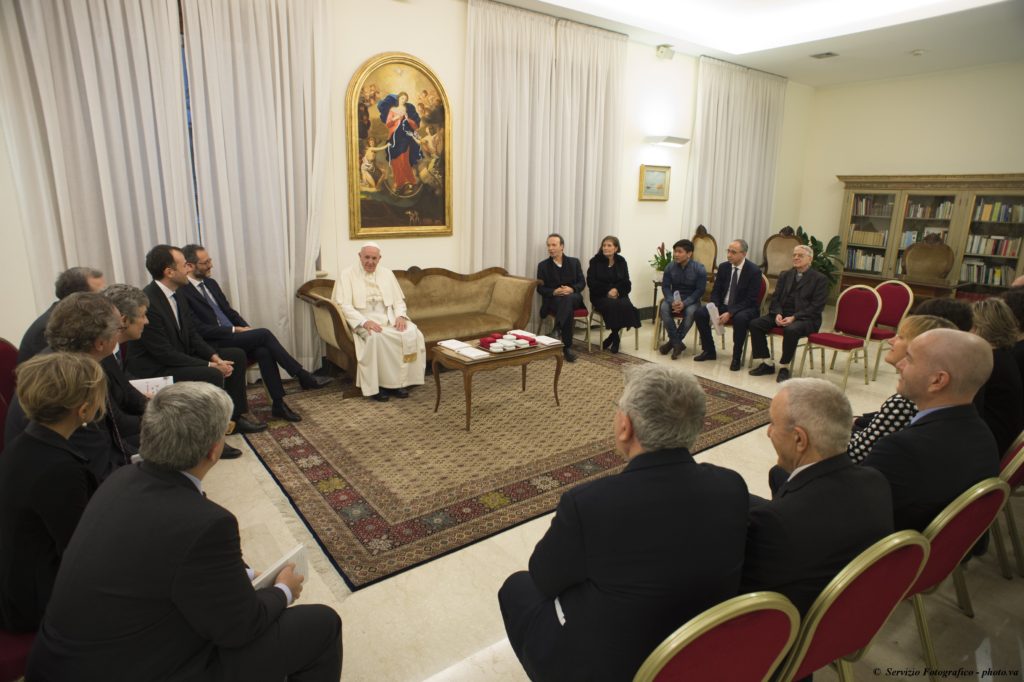
Pope Francis meets with people involved in the publishing of  "The Name of God Is Mercy" at the Domus Sanctae Marthae at the Vatican Jan. 11. The book features an interview the pope did with Italian journalist Andrea Tornielli. (CNS photo/L'Osservatore Romano, handout)
Pope Francis meets with people involved in the publishing of “The Name of God Is Mercy” at the Domus Sanctae Marthae at the Vatican Jan. 11. The book features an interview the pope did with Italian journalist Andrea Tornielli. (CNS photo/L’Osservatore Romano, handout)

By


A book on mercy might be expected to be a warm bath in kindliness, all sweetness and light, but Pope Francis, in “The Name of God Is Mercy,” offers a tough-minded reflection on an urgently needed public virtue, together with firm, if kindly, pushback against his critics.
The Pope’s now mythic line—“Who am I to judge?”—endeared him to many who long for humane authority, but it alarmed those who worry that the traditional center of religious and social order cannot hold. (Who are you to judge? You’re the Pope, that’s who!) That the question was asked in the context of an apparent tolerance of homosexuality made it especially threatening to the culture warriors, for whom gay rights is a flash point. Was the Pope yielding on a point of doctrine? Indeed, was doctrine at risk in his seeming openness to readmitting the divorced and remarried to Communion, or in his refusal to give due emphasis to other touchstone issues of sexual morality? Was there, in the Times columnist Ross Douthat’s incendiary phrase, a “plot to change Catholicism”?
Not that Francis equates himself with Jesus. What makes his book most moving is the way in which this man, without disrespecting his own privacy or offering false bromides of modesty (what Douthat derides as “ostentatious humility”), opens the sacred space of his conscience to explain how he came to center his ministry, and now his papacy, around mercy. “The Pope is a man who needs the mercy of God,” he tells Tornielli. “I said it sincerely to the prisoners of Palmasola, in Bolivia.” Palmasola is the infamous, vastly overcrowded, and hyper-violent penitentiary that Francis visited last July. “Every time I go through the gates into a prison to celebrate Mass or for a visit, I always think: why them and not me?” he says. “I should be here. I deserve to be here.”
In “The Name of God Is Mercy,” Pope Francis lets us see how he came to be the man he is. His most profound and shaping instruction, he says, occurred on the priest’s side of the confessional screen, where he was long entrusted with litanies of suffering, failure, despair, and sin. “When I heard confessions, I always thought about myself, about my own sins, and about my need for mercy, and so I tried to forgive a great deal,” he says. This was what he calls “the gift of confession,” and it was transforming. When he was a parish priest in Argentina, he tells Tornielli, a woman he knew “had to prostitute herself to provide her children with food.” He made sure that she and her children received gifts at Christmastime, but when the woman came to thank him, it was not for that. Rather, she explained that she was grateful “because you never stopped calling me ‘Señora.’ ”
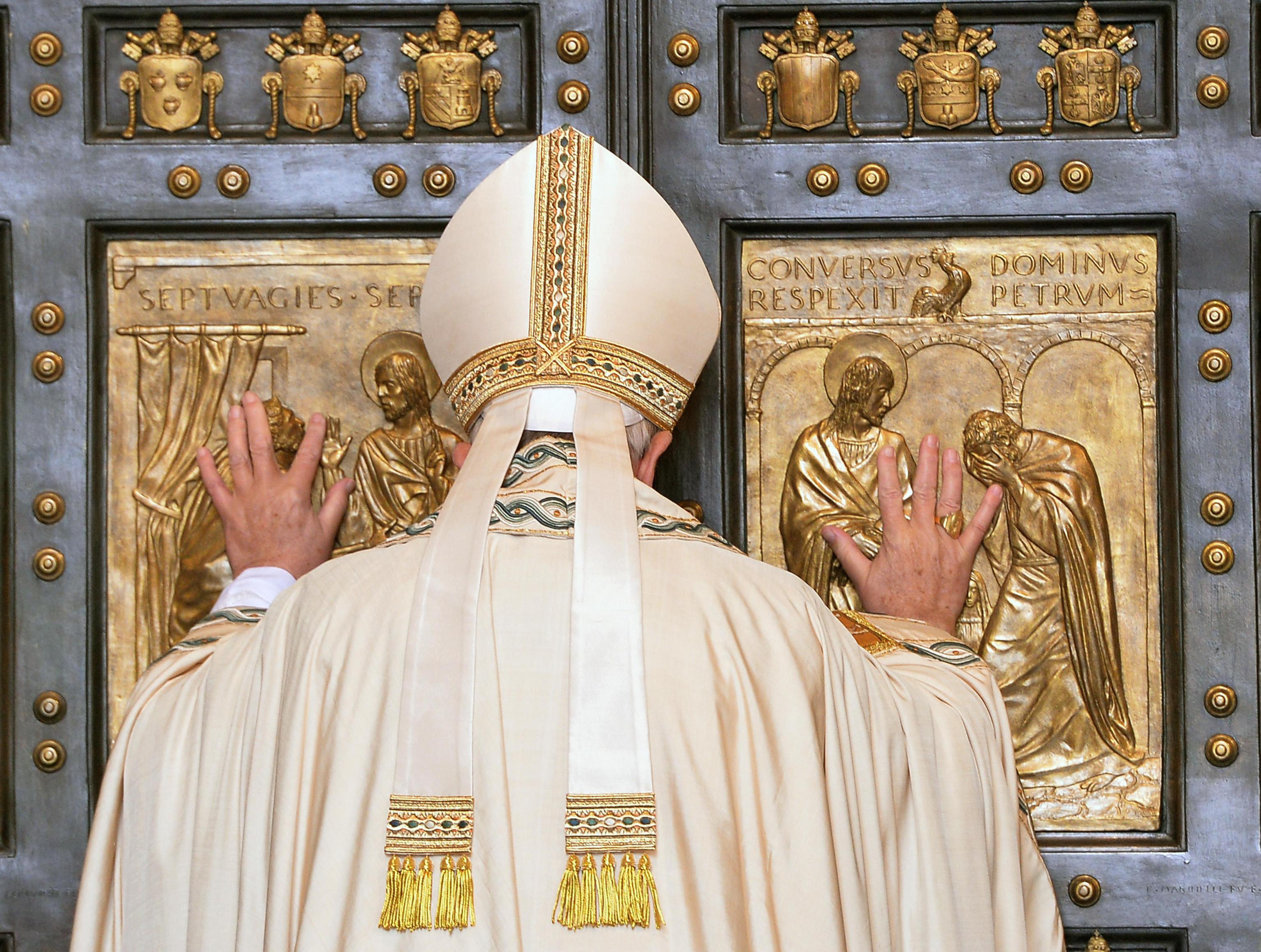
“As a confessor, even when I have found myself before a locked door, I have always tried to find a crack, just a tiny opening, so that I can pry open that door and grant forgiveness and mercy,” Francis says. His new book comes out toward the start of the Extraordinary Jubilee of Mercy, which he inaugurated in December, in a centuries-old ritual, by unlocking the ceremonial Holy Door of St. Peter’s Basilica. The Church of which Jorge Mario Bergoglio became Pope, nearly three years ago, was itself a locked door. As Francis, he has, exactly, found a “tiny opening.” He is pushing, and, to universal surprise, the door is beginning to swing open.

....

Tuesday, January 5, 2016

Jesus: “I have revealed to you the whole ocean of my mercy”.

7 ways that St. Faustina is influencing Pope Francis on mercy

The Holy Year of Mercy has at its core a figure straight out of the St. John Paul II playbook


By John L. Allen Jr.
Associate editor January 4, 2016

ROME — Because Pope Benedict XVI was seen as a man of tradition, it was often easy to miss the innovative aspects of his papacy. In equal-and-opposite fashion, because Pope Francis is seen as a maverick, it’s tempting to overlook the various ways he stands in continuity with his predecessors.
Yet Francis’ signature initiative — probably the thing he would tell you he’s been building toward from the beginning, his Holy Year of Mercy — has at its core a figure straight out of the St. John Paul II playbook.
In fact, there’s a woman behind the pontiff’s jubilee: St. Faustina Kowalska, the Polish nun who launched the worldwide Divine Mercy devotion.

Faustina was an early 20th century mystic who belonged to an order called The Sisters of Our Lady of Mercy. She reported a series of visions, captured in her 700-page diary, in which she said Jesus told her to spread devotion to his mercy under the motto, “Jesus, I trust in you.”
Growing up in Krakow, the young Karol Wojtyla was fascinated that this message of mercy arose in Poland between the two World Wars. Later, as John Paul II, the Polish pope would beatify and canonize Faustina, and he also established a feast of Divine Mercy for the first Sunday after Easter — another request that Faustina said came straight from Jesus.
It’s true that Francis has not talked much about Faustina out loud in connection with his Year of Mercy, leading some devotees to wonder if she’s in danger of becoming the “forgotten woman” of the jubilee.

Yet upon closer examination, it seems clear that her fingerprints are all over it. Consider the following seven indications of her influence on Francis and his thinking about mercy.

1. Papal bull
When Francis issued a formal papal bull decreeing his holy year, titled Misericordiae Vultus, he chose to do so on April 11, 2015 — the vigil of the feast of Divine Mercy, the observance directly associated with Faustina.
“May she, who was called to enter the depths of divine mercy, intercede for us and obtain for us the grace of living and walking always according to the mercy of God and with an unwavering trust in his love,” he wrote.


2. Programmatic line
Looking back, it seems clear that the programmatic line for Francis’ jubilee came during his first airborne news conference returning from a trip to Brazil in July 2013.
Although he was asked specifically about Communion for the divorced and remarried, he gave a broad reply about the importance of mercy. He said he believes the present era is a “kairos” of mercy, using an evocative Greek New Testament term that means a privileged moment in God’s plan of salvation.
In the next breath, Francis cited John Paul II and Faustina.
“But John Paul II had the first intuition of this,” he said, “when he began with Faustina Kowalska, the Divine Mercy …. He had intuited that this was a need in our time.”


3. “Ocean of Mercy”
In his homily for this year’s New Year’s Day Mass, marking his first public utterance of 2016, Francis argued that alongside a “torrent of misery” in the contemporary world, there is also an oft-overlooked “ocean of mercy.”
Though he didn’t explicitly cite Faustina, he easily could have. “Ocean of mercy” is one of her signature phrases, appearing in her diary a robust 16 times.
Here’s a classic for-instance, in this case from one of her visions of Jesus: “I have revealed to you the whole ocean of my mercy,” she reports Jesus saying. “I seek and desire souls like yours, but they are few.”
In another place, Faustina writes that “during Holy Mass, I was given knowledge of the heart of Jesus and of the nature of the fire of love with which he burns for us … he is an ocean of mercy.”

4. Poland trip
At least in terms of crowd size and the magnitude of the event, the highlight of Pope Francis’ jubilee year isn’t likely to come in Rome. Instead it’s likely to be in Krakow in late July, when Francis travels there to lead the Church’s World Youth Day.
Obviously, the legacy of John Paul II and Faustina will be front-and-center throughout that trip.
To make sure no one misses the point, Francis signed off on making John Paul II and Faustina the co-patrons of World Youth Day, referring to them both as “apostles of divine mercy.” The outing shapes as an homage by Francis to Faustina and the pope who canonized her, and one can expect him to reflect on the Divine Mercy devotion at length.

5. The “misericordina”
On Nov. 17, 2013, Francis used his typical Sunday Angelus address to do something more customary in TV infomercials: He hawked a prescription drug, even having people hand out samples in St. Peter’s Square.
Only the “drug,” in this case, wasn’t actually from a pharmacy, even though it was made up to look that way. Instead it was a small packet containing a rosary, the Divine Mercy image with the motto “Jesus, I trust in you,” and instructions for use. Italians call it the misericordina, a play on the word for mercy.
“It’s a spiritual medicine,” the pope told the crowd that day. “Don’t forget to take it, because it’s good for you, it’s good for your heart, your soul, and your whole life.”


6. Roman priests
In March 2014, Francis held a session with priests of Rome in the Vatican’s Paul VI audience hall, saying he wanted to devote it to the theme of mercy. He spoke at length about John Paul II and Faustina.
“In his homily for the canonization, which took place in 2000, John Paul II emphasized that the message of Jesus Christ to Sister Faustina is located, in time, between the two World Wars and is intimately tied to the history of the 20th century,” Francis said, going on to quote several passages from the homily.
In a key line, Francis said, “Today we forget everything far too quickly … but we cannot forget the great content, the great intuitions and gifts that have been left to the People of God. And Divine Mercy is one of these.”
In retrospect, it seems a clear hint that Francis understands his jubilee of mercy as an extension of that “intuition and gift.”


7. Francis in Cuba
When Pope Francis traveled to Cuba just before heading to the United States last September, he chose “messenger of mercy” as the motto for the outing, making it something of a preview of his jubilee.
He said Mass in Havana’s Revolution Square on Sept. 20, and commentators noted the irony that alongside the towering images of Che Guevara and José Martí that dominate the space, there was also a large image of Jesus that was put up for the day.
What was less commented upon, however, was the nature of that depiction: It was the Divine Mercy image, with the motto “Jesus, I trust in you” in Spanish.


An earthier brand of mercy
Granted, the approach Francis takes to the theme of mercy is not simply a photocopy of Faustina’s.
Hers was a highly spiritual version of mercy, focused on compassion for lost souls and people suffering under the weight of sin. Francis’ brand of mercy is earthier, insisting on finding expression in concrete acts of solidarity with the poor, with migrants and refugees, with prisoners, and other victims of what he calls a “throwaway culture.”
That’s why one could make a strong case that the other woman behind the pope’s jubilee is Mother Teresa, and it’s probably no accident that her canonization also seems likely to take place during the year, perhaps in early September.
Yet these are questions of emphasis, not contradiction. Francis certainly would acknowledge that one does not have to be poor to need mercy, and it’s not as if Faustina was blind to the social gospel; the order she joined in Poland, after all, was devoted to helping troubled women, including unwed mothers and prostitutes.
Make no mistake: Francis is a change agent in many respects. But when it comes to his jubilee of mercy, he’s not reinventing the wheel; he’s giving a new push to a wheel that started rolling with a Polish nun and was sped up by a Polish pope.
As a final note, Francis would no doubt also say that Faustina offers a classic illustration of his oft-stated argument that women in Catholicism don’t have to be ordained priests in order to exercise influence.
It’s entirely possible that by the end of the jubilee, it’ll be like a hockey game with three stars of the game acknowledged: Francis, who called it; Faustina, who inspired it, and Mother Teresa, who provided its model for mercy-in-action.
In other words, the female contribution may actually trump that of the male. If so, that’s something in which a pope who’s repeatedly vowed to seek greater roles for women in the Church may find food for thought.

John L. Allen Jr., associate editor, specializes in coverage of the Vatican. More

Saturday, December 19, 2015

Pope Francis was in his element when he opened the ‘Door of Charity’ for the poor

Pope Francis opens the Holy Door of St. Peter’s Basilica to inaugurate the Jubilee Year of Mercy
at the Vatican Dec. 8. (CNS photo/Maurizio Brambatti, EPA)


By John L. Allen Jr.
Associate editor December 19, 2015

ROME — Years from now, records will show that the special jubilee Year of Mercy decreed by Pope Francis began on Dec. 8, 2015, the feast of the Immaculate Conception. If you ask the pontiff himself, however, he’d probably tell you it really got underway on Friday.
That afternoon, Francis headed across town to visit a hostel for the homeless run by Caritas, the main diocesan charity in Rome, in order to open a “holy door of charity.” In a sense, it was the natural follow-up to what happened on Dec. 8, when Francis threw open an ornate door to St. Peter’s Basilica that’s otherwise bricked up when jubilees aren’t underway.
That gesture traditionally is how jubilee years commence, but Friday’s rite was a novelty — a pontiff opening a door not to a church, where spiritual indulgences are on offer, but rather a charity center, where the “grace” dispensed is more tangible and this-worldly.
In most of the ways that matter, this was Pope Francis in his element.
Anyone who spends time watching Francis in action realizes he doesn’t particularly care for big ceremonial productions. He’s most comfortable in smaller, more intimate settings, especially with people who don’t qualify as VIPs, where he can set aside whatever speech has been prepared for him and go off-the-cuff in Spanish or Italian.
Celebrating Mass on Friday for a group of 200 people representing the various activities run by Caritas in Rome — homeless people, AIDS patients, mothers with developmentally challenged children, refugees, and so on — was, to hear Francis tell it, an expression of the heart of what the Year of Mercy is supposed to be all about.
“When we get close to those who are suffering, those who’ve been thrown away in society, that’s where Jesus is,” the pontiff said in his extemporaneous homily.
“If you want to find God, you have to seek him in humility, in poverty, where he’s hidden — in the needy, the neediest, the sick, the hungry, the prisoners,” he said.
The hostel Francis visited Friday afternoon is named for Don Luigi di Liegro, the founder of Caritas in Rome who ran it until his death in 1997. He was famed for bringing together disparate groups — the Salvation Army, Mother Teresa’s Sisters of Charity, Sant’Egidio, among others — into an effective network to serve the city’s poor, its immigrant population, and people often ignored by public institutions, such as residents with mental and psychological difficulties.
The fact that Francis was at home there, however, didn’t mean all was sweetness and light. On the contrary, the pontiff sounded almost like an Old Testament prophet in warning affluent and comfortable Romans about the consequences of indifference.
“Jesus has told us how our judgment will be,” Francis said. “He won’t say: ‘You, come with me because you gave lots of beautiful offerings to the Church, you were a benefactor of the Church, so come into Heaven.’ No, you can’t buy your way into Heaven,” Francis said.
“Jesus won’t say: ‘You were very important, you studied a lot and earned many honors, come into Heaven.’ No. Honors don’t open the door of Heaven.


“What will Jesus say? ‘I was hungry and you gave me something to eat; I was homeless and you gave me a place to live; I was sick and you visited me; I was in prison and you came to see me’.”
Francis offered up a prayer that the Lord will help everyone grasp that “the paths of presumption, of wealth, of vanity, of pride, are not the ways to salvation.”
Looking out at a group of people typically seen as “discarded” by society, Francis said that feeling of being tossed aside is actually a “grace.”
“It would be beautiful if every one of us, all Romans, felt discarded, and thus felt the need of God’s help,” the pontiff said.
Francis celebrated the Mass along with four other priests, including the Rev. Tommas Fanti, who, at 96, is still going strong in serving Rome’s poor. The readings and prayers of the faithful were presented by the people whom Caritas serves; the prayers were actually written by a young mother with a disabled child, a refugee requesting asylum in Italy, and a homeless person living in the hostel Francis was visiting.
Basically, the pope’s message was that these folks are not only what the Year of Mercy is all about, but also the Christmas season.
“In choosing how he’d lead his [human] life, the Lord didn’t pick a great city with a grand empire, he didn’t pick a princess or a countess for his mother, somebody important, and he didn’t choose a luxurious palace,” Francis said.
“It seems that it was all done intentionally,” he said, referring to the Christmas story of Jesus’ birth, in order that the Lord would be “hidden” by the usual worldly standards.
Upon leaving the hostel, Francis urged people to go forward during the jubilee year in an “embrace of mercy.”
Over the coming days, Francis will conduct any number of important engagements: his annual speech to the Roman Curia, the Christmas liturgies, his New Year’s Day Urbi et Orbi blessing, a meeting with the diplomatic corps, and so on.
In terms of getting to the core of what he wants his jubilee year to be about, however, it’s hard to imagine that for him anything will top Friday’s encounter with the “hidden” and “discarded” who clearly form this pope’s comfort zone.

….

Taken from: http://www.cruxnow.com/church/2015/12/19/pope-francis-was-in-his-element-when-he-opened-the-door-of-charity-for-the-poor/

Thursday, December 10, 2015

Pope Francis: God is merciful and steadfast in His love

The Pope speaking during Mass at the Casa Santa Marta on Thursday – OSS_ROM

10/12/2015 12:16

(Vatican Radio) During morning Mass at the Casa Santa Marta on Thursday, Pope Francis spoke of God’s love and encouraged the congregation to allow themselves to be “embraced by God’s mercy”.

Tuesday, December 8, 2015

Pope Francis opens St Peter's Holy Door to launch jubilee


Bernard Gallagher  Mercy


Pope Francis pushed opened the huge bronze Holy Door of St Peter's Basilica in Rome to launch the Catholic Church's "Year of Mercy".
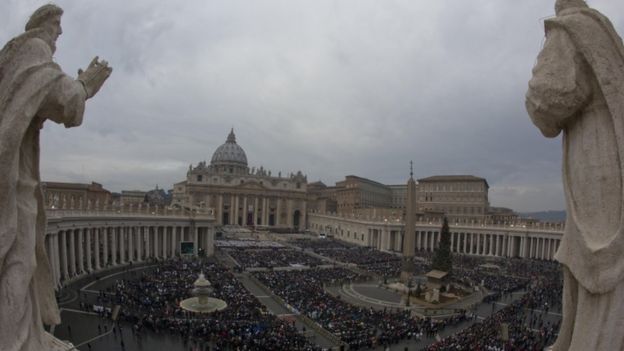
Tens of thousands attended a Mass in St Peter's Square for the start of the Pope's "revolution of tenderness".
It took place place amid tight security with extra police and soldiers deployed, and a no-fly zone imposed.
Under the year's theme of mercy, the Pope has said priests can absolve women who have had abortions.
During the jubilee celebrations, one of the most important events in the Roman Catholic Church, pilgrims travel to Rome and religious sites around the world.
At the end of the Mass, Francis opened the basilica's Holy Door. He said that by passing through it, Catholics should take on the role of the Good Samaritan.
Image copyright EPA
Image caption Pope Francis, centre, has long signalled his wish for the Church to be more forgiving and understanding of its flock
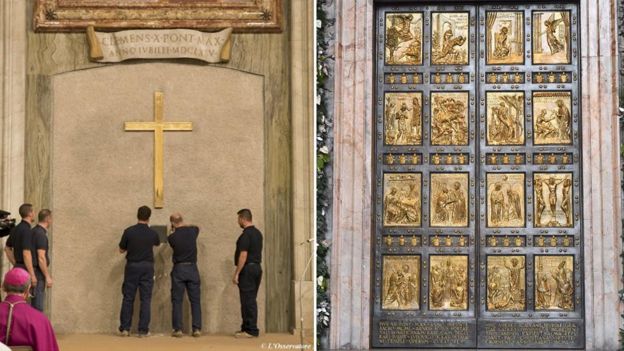
Workers reveal Holy Door of St Peter's Basilica. composite imageImage copyright AFP/Reuters
Image caption Workers had to reveal the Holy Door of St Peter's Basilica, which had been behind a brick wall
It is the first time the Holy Door has been opened since the Great Jubilee in the 2000 called for by St John Paul II. It has been bricked up since then.
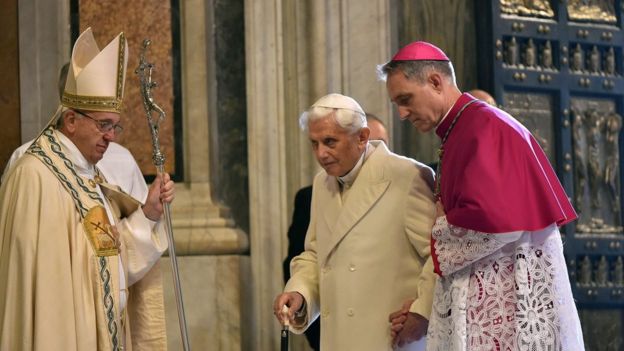
Emeritus Pope Benedict XVI, 88, attended Tuesday's event.

Jubilee Years:

Jubilee years are rooted in the Old Testament tradition of freeing slaves and prisoners once every 50 years, a concept that died out within Judaism but was taken up by Pope Boniface VIII for the Catholic Church in 1300.
Pilgrimages to Rome were at the heart of the original jubilee years, and attracted hundreds of thousands of pilgrims to the city, many willing to pay for "indulgences" - the eradication by the Church of the spiritual debt arising from sin.
It was a tradition that not only contributed copious cash to the Vatican's coffers, but also contributed to the theological turmoil that led to the establishment of rival Protestant churches across much of northern Europe.
The last Jubilee was called by St John Paul II to mark the millennium, and this Holy Year of Mercy starts on the Feast of the Immaculate Conception on 8 December 2015 and will end on the Feast of Christ the King on 20 November 2016.


What is the Catholic Year of Mercy? - by Caroline Wyatt, BBC Religious affairs correspondent

Italian security forces are on high alert following recent attacks in Paris and San Bernardino, California.
Visitors to St Peter's Square had to pass through metal detectors and under go bag and body checks.

More forgiving

Announcing the extraordinary jubilee in March, the Pope said the Holy Door was a "Door of Mercy, through which anyone who enters will experience the love of God who consoles, pardons and instils hope".
Pope Emeritus Benedict XVI is helped by the prefect of the papal household Georg Gaenswein (right) to pass through the Holy Door as Pope Francis (left) looks onImage copyright AFP
Image caption Emeritus Pope Benedict XVI (centre) was among those to pass through the Holy Door as Pope Francis (left) looked on
Pilgrims crowd in St Peter's SquareImage copyright AP
Image caption Ten of thousands of people packed into St Peter's Square for the Mass before the Holy Door was opened
For the first time, he has instructed churches and cathedrals to take part in the tradition of the Holy Door, to help Catholics mark the jubilee at home rather than coming to Rome.
Pope Francis has long signalled his wish to change the Church's approach from condemnation of wrongdoing to a Church that is more forgiving and understanding of its flock, our correspondent says.
This extraordinary jubilee year is seen as a practical way of giving expression to that wish.
Pope Francis took many by surprise when he announced in September that, as part of the jubilee, parish priests across the world would be allowed to absolve repentant women who asked for forgiveness for having an abortion, even though Church teaching still terms abortion a grave sin.


....


Taken from: http://www.bbc.com/news/world-europe-35037740


Monday, December 7, 2015

Francis announces wide indulgences for mercy Jubilee, grants Lefebvrites faculties

  • Pope Francis celebrates Mass at his residence, the Domus Sanctae Marthae, at the Vatican Sept. 1. (CNS/ L’Osservatore Romano via EPA)

Rome
Pope Francis has announced he is widely expanding the traditional indulgences available to Catholics during his upcoming Jubilee Year of Mercy, opening them to anyone who performs just one of the traditional works of mercy and to prisoners who pray at chapels available to them.
The pontiff has also said that he will allow all priests around the world to absolve women who confess to having had abortions, an ability normally reserved only to bishops.
And in a striking move for church unity in expressing God’s mercy, the pope has even granted priests of the schismatic and traditionalist Society of St. Pius X faculties to offer absolution of sins “validly and licitly” to those who approach them for confession.
Francis made the announcement of the new indulgences and abilities in a letter sent Tuesday to the president of the Pontifical Council for the Promotion of the New Evangelization, which is organizing the holy year on his behalf.
The letter, published by the Vatican in seven languages, is striking for the global scope the pontiff envisions the Jubilee year taking, with availability for pardon and mercy seemingly available to all.
Attention subscribers and donors! We’re rolling out an
online account management tool soon. Don’t miss out!
Add or confirm your email address today.
It also addresses women who have had abortion in a respectful way, blaming abortion not so much on them but on “a widespread and insensitive mentality has led to the loss of the proper personal and social sensitivity to welcome new life.”
Regarding the Society of St. Pius X, a traditionalist sect of priests and bishops who widely reject the changes of the Second Vatican Council, the letter says bluntly: “This Jubilee Year of Mercy excludes no one.”
“I trust that in the near future solutions may be found to recover full communion with the priests and superiors of the Fraternity,” states Francis.
“In the meantime, motivated by the need to respond to the good of these faithful, through my own disposition, I establish that those who during the Holy Year of Mercy approach these priests of the Fraternity of St Pius X to celebrate the Sacrament of Reconciliation shall validly and licitly receive the absolution of their sins,” he continues.
On abortion, Francis calls it a “tragedy” that is “experienced by some with a superficial awareness, as if not realizing the extreme harm that such an act entails.”
“Many others,” he writes, “on the other hand, although experiencing this moment as a defeat, believe that they have no other option.”
“I think in particular of all the women who have resorted to abortion,” states the pope. “I am well aware of the pressure that has led them to this decision. I know that it is an existential and moral ordeal. I have met so many women who bear in their heart the scar of this agonizing and painful decision.”
“The forgiveness of God cannot be denied to one who has repented, especially when that person approaches the Sacrament of Confession with a sincere heart in order to obtain reconciliation with the Father,” he continues.
“For this reason too, I have decided, notwithstanding anything to the contrary, to concede to all priests for the Jubilee Year the discretion to absolve of the sin of abortion those who have procured it and who, with contrite heart, seek forgiveness for it,” writes Francis.
“May priests fulfill this great task by expressing words of genuine welcome combined with a reflection that explains the gravity of the sin committed, besides indicating a path of authentic conversion by which to obtain the true and generous forgiveness of the Father who renews all with his presence,” he asks.
Francis opens his letter to Archbishop Rino Fisichella by saying that he wants the holy year to be “for all believers a true moment of encounter with the mercy of God.” He then offers an indulgence, or remission of the punishment for sin, for those that during the year are able to make a pilgrimage to the papal basilicas in Rome or to their local cathedral.
As is traditional, those making those pilgrimages will be asked to make confession, celebrate the Mass, and pray for the pope’s intentions.
But the pope then extends the possibility of indulgence in a special way to those that are sick or imprisoned.
For sick or elderly persons unable to travel, he says: “Living with faith and joyful hope this moment of trial, receiving communion or attending Holy Mass and community prayer, even through the various means of communication, will be for them the means of obtaining the Jubilee Indulgence.”
For those in prison, he states: “The Jubilee Year has always constituted an opportunity for great amnesty, which is intended to include the many people who, despite deserving punishment, have become conscious of the injustice they worked and sincerely wish to re-enter society and make their honest contribution to it.”
“May they all be touched in a tangible way by the mercy of the Father who wants to be close to those who have the greatest need of his forgiveness,” writes the pope. “They may obtain the Indulgence in the chapels of the prisons.”
The pontiff also extends the possibility for forgiveness of sin to anyone who performs one of the traditional spiritual or corporal works of mercy during the year.
“I have asked the Church in this Jubilee Year to rediscover the richness encompassed by the spiritual and corporal works of mercy,” he writes.
“The experience of mercy, indeed, becomes visible in the witness of concrete signs as Jesus himself taught us,” states the pope. “Each time that one of the faithful personally performs one or more of these actions, he or she shall surely obtain the Jubilee Indulgence.”
Francis has called the special Jubilee year for mercy to begin this Dec. 8, the feast of the Immaculate Conception and the 50th anniversary of the closing of the Second Vatican Council. It will close on Nov. 20, 2016, the day celebrated that year as the feast of Christ the King.
In his official proclamation of the year, released in April, the pontiff powerfully called on the entire Catholic church to refashion itself as a place not of judgment or condemnation but of pardon and merciful love.
Granting of special indulgences for the remission of sins during Catholic holy years is a traditional practice, but in the past normally required a visit to one or more of the papal basilicas in Rome. Francis’ letter Tuesday greatly expands the availability of the practice.
The Society of St. Pius X was founded by the late French Archbishop Marcel Lefebvre in 1970 as a response to objections he and others had to the reforms of the Council.
Pope Benedict XVI had sought to repair relations with the group, lifting the excommunications of four of their bishops in 2009. Those efforts ultimately failed when the group’s current superior general, Bishop Bernard Fellay, rejected a doctrinal statement drafted by the Vatican for the group to sign.
Members of the schismatic group are considered not to be in full communion with Rome, and, in normal circumstances, its priests and bishops cannot exercise Roman Catholic ministry.
[Joshua J. McElwee is NCR Vatican correspondent. His email address is jmcelwee@ncronline.org. Follow him on Twitter: @joshjmac.]


….
Taken from: http://ncronline.org/news/vatican/francis-announces-wide-indulgences-mercy-year-grants-lefebvrites-faculties

Sunday, December 6, 2015

Gentle revolution: Pope wants Year of Mercy to tenderly transform world

Image result for year mercy


By Carol Glatz Catholic News Service
12.3.2015 12:26 PM ET

VATICAN CITY (CNS) -- When Pope Francis planned the Year of Mercy and the opening of the Holy Door, he did not mean to give the starting signal for a frenzied wave of pilgrims to Rome.
More than call to sign up for an Eternal City package tour, the pope is inviting people to strike out on a yearlong spiritual journey to recognize a loving God who's already knocking on their door.
He says he wants the Year of Mercy to usher in a "revolution of tenderness."
Once people realize "I'm wretched, but God loves me the way I am," then "I, too, have to love others the same way," the pope said in an interview published just a few days before the Dec. 8 start of the jubilee year.
Discovering God's generous love kick-starts a virtuous circle, which "leads us to acting in a way that's more tolerant, patient, tender" and just, he said.
Speaking with "Credere," an Italian weekly magazine run by the Pauline Fathers, the pope gave an in-depth look at why he sees such an urgent need to highlight God's mercy.
"The world needs to discover that God is father, that there is mercy, that cruelty is not the path, that condemnation is not the path," he said. "Because the church herself sometimes follows a hard line, she falls into the temptation of following a hard line, into the temptation of underlining only moral norms, but so many people remain on the outside," he said.
The pope said the thought of all those people -- sinners, the doubtful, the wounded and disenfranchised -- conjured up that iconic image of seeing the church "as a field hospital after the battle."
"The wounded are to be treated, helped to heal, not subjected to cholesterol tests," he said, meaning a too narrow scrutiny of minutiae delays staving off the broader disease of conflict and indifference. He once illustrated the same concept by painting a visual image of pastors who prefer to coif and comb the wool of the tiny flock in the pews rather than seek the sheep that are outside in danger or lost.
"I believe this is the time for mercy. We are all sinners, we all carry burdens within us. I felt Jesus wants to open the door of his heart," he said in the magazine interview.
The opening of the holy doors in Rome and around the world will be a symbol of how Jesus is opening the door of his heart.
In fact, dioceses have been asked to designate and open their own "Door of Mercy" in a cathedral, an important church or sanctuary. The pope also will send out from Rome "missionaries of mercy" -- priests mandated to the world's peripheries to show patience and compassion in their ministry.
Such gestures suggest the pope still wants people to avoid the expense of travel -- like his post-election suggestion to fans back home in Argentina to give to the poor the money they would have spent for a trip.
To help people at home feel "just like being there" in Rome, the Vatican television center will start broadcasting major papal events during the Holy Year in latest generation "Ultra HD 4K" resolution as well as HD, 3D and standard definition.
With the appropriate displays or TVs, people will be able to watch events with increased depth and detail, and, for the opening of the Holy Door in St. Peter's Basilica Dec. 8, 19 cameras were to be deployed to capture every angle, including a unique papal point of view.
The Vatican also planned to set up 4K screens in a prison in Milan, a hospital in Rome and possibly in the Holy Land so people who are physically confined could feel part of the opening ceremony.
From the very start of his pontificate, Pope Francis has been showing what the way of mercy means.
The pope's very first Angelus address and homily in 2013 centered on mercy, as he explained God always waits for that day of awakening and conversion, then forgives everything. The real problem is people -- not God -- who give up on forgiveness, he said.
But mercy changes everything, he said; it "makes the world a little less cold and more just."
The pope's own religious vocation is rooted in that concrete experience of mercy, when he -- as a 17-year-old student -- walked out of a confessional "different, changed." It was the feast of St. Matthew, and like St. Matthew, he was overcome, feeling "God looked at me with mercy" and said, "Follow me."
Realizing God knows he's a sinner, but embraces him anyway lies at the heart of Pope Francis' ministry and his motto: "By showing mercy, by choosing," based on "The Call of St. Matthew."
He said in the magazine interview that one Friday of every month during the Year of Mercy "I will make a different gesture" that shows God's mercy. He had asked the world's young people to rediscover the corporal and spiritual works of mercy, like feeding the hungry and counsel the doubtful, and choose one to practice each month as they prepare for World Youth Day in July.
The "Credere" interview reveals that the pope has been championing a more merciful church for decades.
In a small group discussion during the 1994 ordinary Synod of Bishops on consecrated life and its role in the church and the world, then then-Auxiliary Bishop Jorge Mario Bergoglio of Buenos Aires, Argentina, he said it was necessary "to institute a revolution of tenderness," to which one synod father countered, "with reasonable explanations," how "it wasn't good to use this kind of language."
But now two decades later as leader of the universal church, the opening of the Year of Mercy may be his moment to set that revolution into motion.

....

Taken from: http://www.catholicnews.com/services/englishnews/2015/pope-wants-year-of-mercy-to-tenderly-transform-world.cfm