Wednesday, July 17, 2013

The Fatima Message

Fatima ShepardsRosary Ladder


Fatima is a call from the Mother of God for a renewed fidelity to penance and prayer, which basically is the message of the Gospel. Too, it brings out the desire of Our Lord that His Mother be better known, loved and venerated through devotion to her Immaculate Heart.


THE REQUESTS OF OUR LADY OF THE ROSARY OF FATIMA


  1. THE DAILY ROSARY FOR PEACE:
    "Pray the Rosary every day in honor of Our Lady of the Rosary to obtain peace in the world . . . for she alone can save it." (Our Lady, July 13, 1917)
    "God has placed peace in her hands, and it is from the Immaculate Heart that men must ask it." (Jacinta, shortly before her death)
    "When you pray the Rosary, say after each mystery: 'O Jesus, forgive us our sins, save us from the fires of hell, lead all souls to Heaven, especially those who have most need of your mercy.' " (June 13, 1917)
      (Every Rosary increases Mary's power to crush the head of the Serpent and to destroy his evil power in the world.)

  2. DEVOTION TO THE IMMACULATE HEART OF MARY:
    "Jesus wishes to establish devotion to my Immaculate Heart in the world. I promise salvation to those who embrace it." (June 13, 1917)
    1. FIRST SATURDAY DEVOTIONS, which include:
      • reception of Holy Communion, and Confession (within 8 days before or after)
      • pray five decades of the Rosary
      • spend 15 minutes in meditation on the mysteries of the Rosary.

      • (All the above to be offered up in reparation for sins and ingratitude against the Immaculate Heart of Our Lady.)
    2. OFFERING IN REPARATION THE SACRIFICES, TRIALS AND CROSSES OF LIFE, especially those sacrifices involved in keeping God's Commandments, and in fulfilling the duties of one's state in life - offering them through the Immaculate Heart of Mary in reparation to the Divine Majesty so offended by sin, and for the conversion of sinners.
      "Sacrifice yourselves for sinners and say often whenever you make a sacrifice: 'O Jesus, it is for love of You, for the conversion of sinners, and in reparation for the offenses committed against the Immaculate Heart of Mary.' " (Our Lady, July 13, 1917)
      "Pray much and make sacrifices for sinners, for many souls go to hell because there is no one to make sacrifices for them." (Our Lady, August 19, 1917)
    3. CONSECRATION TO THE IMMACULATE HEART OF MARY. Any formula may be used which expresses a sincere confiding of oneself without reserve.


    The Fatima Message:


....

Taken from: http://www.rosary-center.org/fatima.htm

Thursday, July 11, 2013

"Make sacrifices for sinners".


Apparition of 13 July 1917

As the July date approached Lucia continued to be troubled by the words of her pastor that the devil might be behind the apparitions. Finally, she confided to Jacinta that she intended not to go. When the day finally dawned, however, her fears and anxieties disappeared, so that the noon hour found her in the Cova with Jacinta and Francisco, awaiting the arrival of the beautiful Lady.
The apparition of July 13th would prove to be in many ways the most controversial aspect of the message of Fátima, providing a secret in three parts which the children guarded zealously. The first two parts, the vision of hell and the prophecy of the future role of Russia and how to prevent it, would not be revealed until Sr. Lucia wrote them down in her third memoir, at the request of the bishop, in 1941. The third part, usually called the Third Secret, was only later communicated to the bishop, who sent it unread to Pope Pius XII.
Video

A few moments after arriving at the Cova da Iria, near the holmoak, where a large number of people were praying the Rosary, we saw the flah of light once more, and a moment later Our Lady appeared on the holmoak.

"Lucia," Jacinta said, "speak. Our Lady is talking to you.
"Yes?" said Lucia. She spoke humbly, asking pardon for her doubts with every gesture, and to the Lady: "What do you want of me?"
I want you to come back here on the thirteenth of next month. Continue to say the Rosary every day in honor of Our Lady of the Rosary, to obtain the peace of the world and the end of the war, because only she can obtain it. "Yes, "yes."
"I would like to ask who you are, and if you will do a miracle so that everyone will know for certain that you have appeared to us."
You must come here every month, and in October I will tell you who I am and what I want. I will then perform a miracle so that all may believe.
Thus assured, Lucia began to place before the Lady the petitions for help that so many had entrusted to her. The Lady said gently that she would cure some, but others she would not cure.
"And the crippled son of Maria da Capelinha?"
No, neither of his infirmity nor of his poverty would he be cured, and he must be certain to say the Rosary with his family every day.
Another case recommended by Lucia to the Lady's assistance was a sick woman from Atougia who asked to be taken to heaven.
Tell her not to be in a hurry. Tell her I know very well when I shall come to fetch her."
Make sacrifices for sinners, and say often, especially while making a sacrifice: O Jesus, this is for love of Thee, for the conversion of sinners, and in reparation for offences committed against the Immaculate Heart of Mary. As Our lady spoke these words she opened her hands once more, as had during the two previous months. The rays of light seemed to penetrate the earth, and we saw as it were a sea of fire. Plunged in this fire were demons and souls in human form, like transparent burning embers, all blackened or burnished bronze, floating about in the conflagration, now raised into the air by the flames that issued from within themselves together with great clouds of smoke, now following back on every side like sparks in huge fires, without weight or equilibrium, amid shrieks and groans of pain and despair, which horrified us and made us tremble with fear. (it must have been this sight which caused me to cry out, as people say they heard me do). The demons could be distinguished by their terrifying nad repellant likeness to frightful and unknown animals, black and transparent like burning coals. terrified and as if to plead for succor, we looked up at Our Lady, who said to us, so kindly and so sadly:
You have seen hell, where the souls of poor sinners go. It is to save them that God wants to establish in the world devotion to my Immaculate Heart. If you do what I tell you, many souls will be saved, and there will be peace. This war will end, but if men do not refrain from offending God, another and more terrible war will begin during the pontificate of Pius XI. When you see a night that is lit by a strange and unknown light [this occurred on January 28, 1938], you will know it is the sign God gives you that He is about to punish the world with war and with hunger, and by the persecution of the Church and the Holy Father.
To prevent this, I shall come to the world to ask that Russia be consecrated to my Immaculate Heart, and I shall ask that on the First Saturday of every month Communions of reparation be made in atonement for the sins-of the world. If my wishes are fulfilled, Russia will be converted and there will be peace; if not, then Russia will spread her errors throughout the world, bringing new wars and persecution of the Church; the good will be martyred and the Holy Father will have much to suffer; certain nations will be annihilated. But in the end my Immaculate Heart will triumph. The Holy Father will consecrate Russia to me, and she will be converted, and the world will enjoy a period of peace. In Portugal the faith will always be preserved... [Here belongs the part of the Secret of which Cardinal Sodano spoke at the Mass of Beatification, and which the Congregation for Doctrine of the Faith will publish, with commentary.] Remember, you must not tell this to anyone except Francisco.
When you pray the Rosary, say after each mystery: O my Jesus, forgive us, save us from the fire of hell. Lead all souls to heaven, especially those who are most in need.
"Is there anything more that you want of me?"
No, I do not want anything more of you today.
Then as before Our Lady began to ascend towards the east, until she finally disappeared in the immense darkness of the firmament.
The possession of the Secret proved to be very great trial for the three young ones. Family, neighbors, followers of the apparitions, even the clergy, tried unsuccessfully to get them to reveal it. Finally, as the day of the August apparition approached even the civil government, which was secular and virulently anti-clerical, alarmed by the numbers of people taking an interest in the Fátima events, attempted to wrest it from them and in the process expose the Church as a collaborator in a fraud.
Back


Tuesday, July 2, 2013

Pope Francis: prayer requires courage, tenacity

 
2013-07-01 Vatican Radio
 
(Vatican Radio) We must pray with courage to the Lord, and with tenacity just as Abraham did. That’s what Pope Francis said to the faithful gathered for early morning Mass in the chapel of the Vatican guest house Santa Marta Monday. The Pope reiterated that praying is also “negotiating with the Lord,” even coming “out of left field” as Jesus teaches us.
Listen to Tracey McClure's report:
Cardinal Kurt Koch, President of the Pontifical Council for Promoting Christian Unity and Secretary Bishop Brian Farrell concelebrated today’s mass which was attended by members and staff of the same council.
In his homily, Pope Francis referred to Abraham’s courage and tenacity in appealing to the Lord to spare the city of Sodom from destruction. Pope Francis drew from the First Reading, observing that “Abraham is a courageous man and prays with courage.” Abraham, he said, “finds the strength to speak face to face with the Lord and attempts to defend that city.” And he does it with tenacity. In the Bible therefore, the Pope said, we can see that “prayer must be courageous.”
 
“When we speak of courage we always think of apostolic courage – going out to preach the Gospel, these sort of things…But there’s also (the kind of) courage (demonstrated) before the Lord. That sense of paralysis before the Lord: going courageous before the Lord to request things. It makes you laugh a bit; this is funny because Abraham speaks with the Lord in a special way, with this courage, and one doesn’t know: is this a man who prays or is this a‘phoenician deal’ because he’s bartering the price, down, down…And he’s tenacious: from fifty he’s succeeded in lowering the price down to ten. He knew that it wasn’t possible. Only that it was right…. But with that courage, with that tenacity, he went ahead.”
 
Sometimes, the Pope said, one goes to the Lord “to ask something for someone;” one asks for a favor and then goes away. “But that,” he warned, “is not prayer,” because if “you want the Lord to bestow a grace, you have to go with courage and do what Abraham did, with that sort of tenacity.” The Pope recalled that Jesus himself tells us that we must pray as the widow with the judge, like the man who goes in the middle of the night to knock on his friend’s door. With tenacity.
In fact, he observed, Jesus himself praised the woman who tenaciously begged for the healing of her daughter. Tenacity, said the Pope, even though it’s tiring, is really “tiresome.” But this, he added, “is the attitude of prayer.” Saint Teresa, he recalled, “speaks of prayer as negotiating with the Lord” and this “is possible only when there’s familiarity with the Lord.” It is tiring, it’s true, he repeated, but “this is prayer, this is receiving a grace from God.” The Pope stressed here the same sort of reasoning that Abraham uses in his prayer: “take up the arguments, the motivations of Jesus’ own heart.”
 
“To convince the Lord with the Lord’s own virtues! That is beautiful! Abraham’s appeal goes to the heart of the Lord and Jesus teaches us the same: ‘the Father knows things. The Father – don’t worry – sends rain down on the just and the sinners, the sun for the just and for the sinners.’ With that argumentation, Abraham forges ahead. I will stop here: praying is negotiating with the Lord, even becoming inappropriate with the Lord. Praying is praising the Lord in the beautiful things he shares and telling him that he bestow these beautiful things on us. And (appealing to him) who is so merciful, so good, to help us!”
 
Pope Francis then urged everyone to spend no more than five minutes each day to read Psalm 102:
 
‘Bless the LORD, O my soul;
and all my being, bless his holy name.Bless the LORD, O my soul,
and forget not all his benefits. He pardons all your iniquities,
he heals all your ills.He redeems your life from destruction,
he crowns you with kindness and compassion.’
 
“Pray all of this psalm and with this we learn the things we must say to the Lord when we request a grace. ‘You who are Merciful and forgiving, grant me this grace:’ just as Abraham did and as Moses did. We forge ahead in prayer, courageous, and with these motivations which come right from the heart of God himself.”

....

Taken from: http://www.news.va/en/news/pope-francis-prayer-requires-courage-tenacity

Thursday, June 20, 2013

Vatican theologians ‘have approved second John Paul II miracle’


By on Wednesday, 19 June 2013
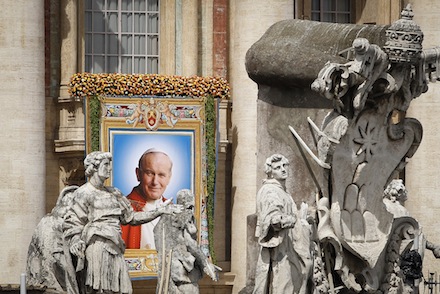
John Paul II was beatified on May 1 2011 (CNS)
Italian media are reporting that the canonisation of Blessed John Paul II is another step closer.

Although the process is not complete and is supposed to be secret at this point, the Italian news agency ANSA and many Italian papers say Vatican sources confirmed yesterday that the theological consultants to the Congregation for Saints’ Causes affirmed that the description of prayers and events surrounding an alleged miracle provide evidence that the healing was accomplished through the intercession of the late pope.

The congregation’s board of physicians had said in April that there was no natural, medical explanation for the healing, which apparently involves a woman from Latin America healed on May 1 2011, just hours after Blessed John Paul was beatified.

Even if the news about the theological consultants is true, the cardinals who are members of the congregation still must vote on whether to recommend that the Pope recognise the healing as a miracle. The papal decree is needed before a canonisation date can be set.

Cardinal Stanisław Dziwisz of Kraków, Blessed John Paul’s secretary, and many others are hoping the canonisation can be celebrated in October around the 35th anniversary of Pope John Paul’s election on October 16 1978.

....

Taken from: http://www.catholicherald.co.uk/news/2013/06/19/vatican-theologians-have-approved-second-john-paul-ii-miracle/

Tuesday, June 18, 2013

Esther, it turns out, describes an entirely intra-Jewish affair set in the Persian Empire.


Power struggle between Jews

Clever Queen Esther takes a chance and manages to create harmony.


 EUGENE KAELLIS

Purim is based on the Book of Esther, the most esoteric book in the Hebrew Testament. Accepting a literal interpretation of the book is impossible. It is laden with evident exaggerations and inventions that defy what is known of Persian history and conventions. Its hidden meaning can be uncovered only by combining a knowledge of Persian practices during the Babylonian Captivity, the conquest of Babylon by Cyrus the Great, his Edict (sixth century BCE) and Ginzberg's Legends of the Jews which, despite its name, contains a great deal of relevant and credible history.
Using these sources, one can arrive at a plausible interpretation completely in accord with historically valid information. Esther, it turns out, describes an entirely intra-Jewish affair set in the Persian Empire, with the two major antagonists as factional leaders: Mordecai, whose followers advocate rebuilding the Jerusalem Temple, and Haman, also a Jew, whose assimilationist adherents oppose the project.
Ginzberg furnishes substantial evidence that Mordecai and Haman were both Jews who knew each other well: they were co-butlers at a royal feast and journeyed together to India to put down a rebellion against Persia. Moreover, Haman's mother had a Hebrew name and his descendants are said to have taught Torah in Akiva's academy.
The multi-ethnic Persian Empire had significant religious freedom and communal authority, as exemplified by the Edict of Cyrus, permitting Jews to return to Judah and rebuild their Temple, destroyed by the Babylonians, and allowing the inclusion of members of various ethnic and religious groups under Persian rule, offering them some representation and influence at the royal court. However, it is untrue that Mordecai or Esther achieved the high positions attributed to them in the book. Queens and chief ministers always had to have impeccably Persian ancestry. More likely, Mordecai was a spokesperson for much of the Jewish community and Esther, a harem consort.
In the Persian Empire the king's harem typically had ethnic "representatives." Vashti, Esther's predecessor, was a member of the Hamanite faction. In a typically irreverent manner, she had forced her Jewish handmaidens to violate the Sabbath. After Vashti's dismissal, widespread rebellion and Jewish inter-factional fighting flared up, calmed only by Mordecai's elevation and the appointment of Esther, who, in a measure of intrigue, initially conceals her ethnic and factional identification. Her original name was Hebrew, viz., Hadassah; Esther is Persian, derived from Astarte or Ishtar.
The book states that Mordecai first discovered a plot to kill Ahasuerus, the king. It is more likely that he was apprised by Esther who, being in the harem, a traditional centre of intrigue and espionage, would have picked up this intelligence. A more plausible explanation is that the incident was a conspiracy arranged by Mordecai, the two allegedly guilty harem eunuchs becoming dupes in a plot designed to be exposed in order to discredit the Hamanite faction and win favor for Mordecai and his followers.
Nevertheless, Haman initially gains the upper hand by convincing Ahasuerus that Mordecai's faction threatens the king's hegemony, an argument given credence by the plan of the pro-Temple faction to construct a wall around the rebuilt Temple, perhaps to defend against Persian armies after the Jews had declared their independence. Haman also probably bribes the king with promises of a share of the plunder expropriated from the wealth of the pro-Temple faction after its members are killed.
After Haman's appointment, when he and the king sat down for a drink, "Susa was perplexed," the text states, indicating that the Jews of Susa, a city with a large Mordecai-supporting faction, were outraged that someone they considered a heretic would henceforth officially advise the king regarding the Jewish community.
As Haman puts his plan in motion, Mordecai warns Esther, and the pro-Temple Jews demonstrate their solidarity with her. During the three days of fasting, while Esther prepares to petition the king, Mordecai is busy collecting a counter-bribe, referred to as "relief and deliverance ... from another quarter," which he had earlier promised Esther while trying to assuage her fears about her own safety following the disclosure of her true allegiance.
The Mordecai faction succeeds and the tolerant but venal king switches his support. Esther gathers information on Haman's collaborators and denounces him. In a staged event in the royal apartment, with the king's co-operation, she frames Haman on an assault charge, providing Ahasuerus with a face-saving device to explain the dismissal and subsequent execution of someone he had so recently elevated.
Ahasuerus, now convinced that the pro-Temple faction does not threaten him with its walled city plans, provides help from forces he had formerly promised to Haman, allowing the Mordecaite Jews to eliminate the Hamanites, but keeping his well-greased hands out of the more violent aspects of the conflict.
The book states repeatedly that the pro-Temple faction members kept no plunder derived from the defeat of their rivals, indicating that this benefit of their triumph went to Ahasuerus. The story goes on to declare that, with the victory of the Mordecai faction, "many people of the country declared themselves Jews, for the fear of the Jews had fallen upon them." Why would ordinary Persians or Babylonians, now part of the Persian Empire, fear Jews to the point of embracing a minority religion in their own country? It is more reasonable to assume that the now religiously enthusiastic Jews who had become fearful of Mordecai were assimilated Jews who had identified themselves as Persians and who had formerly allied themselves with the Hamanite faction or had previously faltered in their allegiance to the pro-Temple faction.
Purim is at once the least and the most profound of Jewish holidays. The Talmud tells us that even after the Messiah comes and the mandated holidays of Pesach, Shavuot and Sukkot are no longer celebrated, Purim will be retained. Why? Because the story reminds us that, even when obscured by bizarre circumstances, there is a continuous presence of God, often in the guise of "chance," which explains why Purim is known as the Feast of Lots.
The mood in the synagogue celebration of Purim is one of noisy revelry, even inebriation, and self-ridicule as if the participants somehow know that the book's story is a cover up for a series of dramatic and fateful events and they are winking at it and themselves.

Dr. Eugene Kaellis is a retired academic living in New Westminster.

....

Taken from: http://www.jewishindependent.ca/Archives/Mar05/archives05Mar18-07.html

Friday, June 7, 2013

Transubstantiation into the Immaculate, in the Thought of St. Maximilian Kolbe


05FridayApr 2013


Posted by in Spirituality

....

Transformation into Our Lady has been spoken of by the saints for many centuries. In True Devotion to the Blessed Virgin, St. Louis de Montfort, repeats the words of St. Ambrose, writing, “The soul of Mary will be communicated to you to glorify the Lord. Her spirit will take the place of yours to rejoice in God, her Savior…”(1). It is St. Maximilian, however, who has given this transforming union its boldest and most descriptive formulation: “transubstantiation into the Immaculate.”
The Eucharistic terminology is very enlightening. St. Maximilian speaks of Mary’s devotees being changed, as it were, into Our Lady. One becomes, “in a certain sense, her living, speaking and working in this world” (2). Negatively, this means the uprooting of sin and imperfection. Positively, it entails growth in Charity and sanctity. “Let yourselves be led by the Immaculate, let Her form you with an ever greater freedom and you will become like Her, because She will make you ever more immaculate and She will nourish you with the milk of Her grace” (3).
At a certain point, this transforming union becomes so radical, the term “transubstantiation,” used analogously, becomes a very descriptive and accurate way to express the extent of Marianization. St. Maximilian writes, “We want to be so much the Immaculate’s that there remains nothing in us that is not Hers, that instead we come to be annihilated in Her, changed into Her, transubstantiated into Her, that She herself alone remains. That we might be thus Hers, as She is God’s” (4).
St. Maximilian thus draws an analogy between the relationship we seek to have with Our Lady, and her own union with God. Describing this union, he gives the Latin formulation: Filius incarnatus est: Jesus Christus. Spiritus Sanctus quasi incarnatus est: Immaculata (5). That is, “The Son is incarnate: Jesus Christ. The Holy Spirit is quasi incarnate: the Immaculata.” St. Maximilian elaborates:
The Holy Spirit manifests his share in the work of Redemption through the Immaculate Virgin who, although she is a person entirely distinct from him, is so intimately associated with him that our minds cannot understand it. So, while their union is not of the same order as the hypostatic union linking the human and divine natures in Christ, it remains true to say that Mary’s action is the very action of the Holy Spirit (6).
Mary’s actions are the very actions of the Holy Spirit, and as St. Maximilian points out elsewhere, the Holy Spirit acts always (by His own divine decree) through Mary. These two persons operate as if they are, so to speak, one person. This union is founded on the grace of the Immaculate Conception: Our Lady’s first grace, and that which radically conforms her to her Spouse, such that, in the words of St. Maximilian, she is the created Immaculate Conception, whereas the Holy Spirit is the Uncreated Immaculate Conception (7). The Blessed Virgin is a manifestation of her Spouse. St. Maximilian writes, “Just as the Son, to show us how great his love is, became a man, so too the third Person, God-who-is-Love, willed to show his mediation… by means of a concrete sign. This sign is the heart of the Immaculate Virgin…” (8).
Transubstantiation into the Immaculate means being changed into her, such that one’s actions are truly hers. We become concrete manifestations of the Blessed Virgin, “in a certain sense, her living, speaking and working in this world” (9). In this way, we become hers, as she is God’s.
Both the positive and negative dimensions of this transubstantiation are achieved through total consecration to the Immaculate. Such a consecration means entrusting ourselves to her maternal Heart; placing all of our goods, corporeal and spiritual, at her disposal; and doing everything for her honor. It further entails a real striving to imitate Our Lady interiorly and exteriorly, and to fulfill her will in all things. “Let us strive to live in such a way that every day, every moment, we become ever more the property of the Immaculate, fulfilling always more perfectly the will of the Immaculate” (10).
It is interesting to note that St. Maximilian promoted total consecration without having knowledge of St. Louis de Montfort’s True Devotion. He became familiar with this classic little treatise only later in life. Instead, his devotion is drawn from the Franciscan tradition, which profoundly shaped all of his theological insights. He wrote to a confrere:
For seven centuries we strove for the recognition of the truth of the Immaculate Conception, and our efforts were crowned with the proclamation of the dogma and the apparition of the Immaculate at Lourdes. Now we move on to the second part of the story: the sowing of the seed of this truth in souls, fostering its growth and ensuring that it produce fruits of sanctity. And this in all souls who are and who will be until the end of the world (11).
In St. Maximilian’s view, the Immaculate Conception may be likened to a blueprint. In the first chapter of Franciscan history, the order strove to make this blueprint known by all the Church‒ an effort which ended with a definitive victory in 1854. Now, according to St. Maximilian, the blueprint must be implemented throughout the Church by means of Marian consecration. With this consecration, lived out authentically, the faithful can be increasingly transubstantiated into the Immaculate, and thus, patterned ever more closely on the Immaculate Conception‒ Our Lady herself.
The more this transformation takes hold, the more one becomes, as it were, an extension of Mary. The soul acquires an increasingly profound insertion into the depths of the Holy Trinity. Exteriorly, however, the person appears no different from any other. Here we see again, how carefully chosen and enlightening St. Maximilian’s terminology really is. At Holy Mass, the accidents of bread and wine remain in place, even after the consecration. Likewise, transubstantiation into the Immaculate entails a radical change, but leaves the exterior appearance intact. No one could guess, simply by looking at a true Marian devotee, the degree to which his soul is flooded with grace.
The analogy is likewise instructive as to the proper mode of evangelization for Catholics. If one’s sanctity consists in being Marianized, then hiding the truth about Our Lady amounts to concealing the means of sanctification. Obfuscating Mary’s necessity, beauty, and queenship, can be likened to hiding the truth about the Blessed Sacrament.
St. Maximilian’s formulation, “transubstantiation into the Immaculate,” also draws attention to the relationship between the Holy Eucharist and the Blessed Virgin. Eucharistic mediation is profoundly Marian, and Marian mediation cannot be other than Eucharistic. Jesus and Mary are indissolubly united, including in the Blessed Sacrament and, “Therefore what God has joined together, let no man separate,” (12).
The Church and Our Lord are united in a spousal manner. As in all spousal unions, however, a real distinction remains. The Personhood of Christ is that of the Son of God, while the personality of the Church is strictly Marian. Herein lays the distinction between Christ and the Church. Reflection on this point cannot fail, however, to also shed light on the union between Christ and His Church, since, “Jesus and Mary always go together,” as St. Bernadette puts it.
The genius of St. Maximilian’s terminology lies, in part, in his succinctly locating the Christification of the Church (we might say, transubstantiation into the Eucharist), and each of its members, precisely in Marianization. The Holy Spirit is the “Soul” of the Church, and Our Lady is the Spouse, or better still, Quasi-Incarnation, of the Holy Spirit. This accounts for the Marian presence which pervades the entire Church, which Bl. John Paul II writes of in Redemptoris Mater. It also illustrates why sanctification‒ that is, Christification‒ can only mean Marianization.
The reflections and insights of the Franciscan saints on Our Lady have developed within a unique, yet thoroughly Catholic tradition. The thought of St. Maximilian is no exception. His insights, like those of St. Bonaventure, Bl. John Duns Scotus, St. Bernardine of Siena, and St. Leonard of Port Maurice, have developed in a manner congruous with the charism and spirituality of the Seraphic Father. It has rightly been said that Franciscan theology flows from the stigmatized heart of St. Francis.
The content of Franciscan Mariology can be found in the thought of St. Francis himself, albeit, stripped of academic terminology. He calls Our Lady the “Spouse of the Holy Spirit” rather than the Immaculate Conception; instead of Co-redemptrix, “Handmaid”; and rather than Type or Exemplar of the Church, “Virgin made Church.” These themes have formed the core of Franciscan Mariological thought, centered on the Immaculate Conception as the metaphysical basis for Marian mediation‒ both in its mode (virginal-maternal, whether we speak of the objective or subjective redemption) and in its end, namely, the growth of the Church and each of its members into the likeness of the Immaculate.
The thought of St. Maximilian represents a simple development in this Mariology. At San Damiano, Christ gave St. Francis, and the Franciscan Order, a mission: “Rebuild my Church.” Franciscans of every age have held that Mary, qua Immaculate Conception, is both the blueprint to be followed and the means of success in this mission.

Notes
(1) Bay Shore, NY: Montfort Publications, 2001, p. 112
(2) SK# 486
(3) SK# 1334
(4) SK# 508
(5) Bonamy, 63, quoting from Sketch by Kolbe, 1940
(6) Miles Immaculatae. I, 1938. Emphasis added
(7) H. M. Manteau-Bonamy, O.P., Immaculatae Conception and the Holy Spirit, trans. Richard Arnandez, F.S.C. (Kenosha, Wisc.: Prow Books/Franciscan Marytown Press, 1977), 2-3, quoting from Final Sketch
(8) Miles Immaculatae. I, 1938
(9) SK# 486
(10) SK# 1232
(11) SK# 485
(12) Mark 10:9

Wednesday, June 5, 2013

“Law on abortion … an insult to the Virgin”.


Man who Pope Francis allegedly performed an exorcism on claims to be still possessed - VIDEO

Mexican father-of-two says, “I still have demons inside me,” despite 30 exorcisms by 10 exorcists


Pope Francis I laying his hands on Mexican father-of-two, Angel V, at the Vatican on May 19. The Mexican man claims he is still possessed by demons.
Photo by TV2000


The 43-year-old Mexican father-of-two, identified only as Angel V, who Pope Francis prayed over at the Vatican on May 19, claims he is still possessed by demons.

Media and experts alike believed that the newly elected Pope had performed an exorcism of sorts on the then unidentified man, at St Peter’s Square in Rome. However the Pope’s prayers seem to have been in vain, the Mexican man told the Spanish Language newspaper, El Mundo.

Angel V said, “I still have demons inside me, they have not gone away.” He added that he did feel better since the Pope prayed over him.

He told the newspaper that he has undergone 30 exorcisms by ten exorcists to no avail. These exorcists included the renowned Roman exorcist Reverend Gabriel Amorth.

The father-of-two is able to walk but was in a wheelchair on that particular day, captured by TV2000, on Pentecost Sunday.

An exorcism is a casting out of evil spirits using a precise ritual.

On May 19 Pope Francis was seen “laying his hands” on Angel V. This is a very ancient practice going back to the Old Testament.

When the Pope laid his hands on Angel V his facial expressions and the fact that he was known to be possessed made it appear to be an exorcism. The Vatican denied this and said the Pope “did not intend to perform any exorcism" but prayed "for a suffering person who had been brought before him."

Angel V is married and lives in the state of Michoacán. He claims he has been possessed by demons since 1999.

Reverend Juan Rivas, a well-known Mexican priest, accompanied Angel V to Rome. He was with him when the Pope laid his hands on the allegedly possessed man.

He told El Mundo, “the demons that live in him do not want to leave him.”

Rivas, a member of the Legionaries of Christ, said Angel V kissed Pope Francis’ ring and then fell into a trance.

He said, “The Pope then laid his hands on his head and at that moment a terrible sound was heard (from him), like the roar of a lion.

“All those who were there heard it perfectly well. The Pope for sure heard it [but] he continued with his prayer, as if he had faced similar situations before.”

The Mexican father told El Mundo how he came to be possessed. He was on a bus in 1999 when he felt “an energy” enter the bus.

“I did not see it with my eyes, but I perceived it.

“I noted that it came close to me, and then stopped in front of me. Then, suddenly, I noted that something like a stake pierced my chest and, little by little, I had the sensation that it was opening my ribs.”

He said he thought he would die and thought he was having a heart attack.

From that day on his health deteriorated. He couldn’t keep food down, felt pain and needles all over. Then he began to have difficulty walking and breathing.

“I could not sleep, and when I managed to sleep I had terrible nightmares connected with the evil one,” he explained

Angel V also began falling into trances. While in these trances he would blaspheme and speak in tongues.

He said doctors “could not get to the cause of my problems.”

Priests gave Angel V the Extreme Unction (a sacrament administered to the sick) four times. Although it relieved his symptoms for a short while it did not remove them.

Angel V, still a strong Catholic, believes that the power of God will help him.

He said he lives with “much fear” and feels “very dirty at the thought that there was an evildoer within me.”

Over the past few years he has sought out exorcists but none of them have cast out his demons.

He said the possession has turned into a nightmare. He has lost his publicity business and some real estate. Happily his family have stood by him.

"Fortunately, my children have never seen me in a trance, though they know I am ill,” he explained.

Rev. Gabriel Amorth, an expert in exorcism who is based in Rome, believes that Angel V is possesed.

He said, “Not only is he possessed, but the devil who lives in him finds himself obliged by God to transmit a message," he said.

Amorth continued, “Angel is a good man. He has been chosen by the Lord to give a message to the Mexican clergy and to tell the bishops that they have to do an act of reparation for the law on abortion that was approved in Mexico City in 2007, which was an insult to the Virgin.

“Until they . . . do this, Angel will not be liberated.”

Here’s the clip:


Read more: http://www.irishcentral.com/news/Man-who-Pope-Francis-allegedly-performed-an-exorcism-on-claims-to-be-still-possessed----VIDEO-210049301.html#ixzz2VJMFOprA
Follow us: @IrishCentral on Twitter | IrishCentral on Facebook